Have you ever stood in a hardware store and wondered, Do I need a nut or a bolt? You are not alone. Many people search for “nut or bolt” because the two items are often used together, look related, and are sometimes confused in speech and writing.
Beginners, DIY fans, students, and even professionals pause to check which term fits their situation.
The confusion usually comes from function. Both nuts and bolts are fasteners. They often work as a pair, so people mix up their names or use one word to mean both. In writing, this can cause unclear instructions, wrong orders, or simple mistakes.
This article clears that up in a simple way. You will learn the quick difference between a nut or bolt, where the words come from, and how English uses them in British and American contexts.
You will also see common mistakes, everyday examples, and clear advice on which term to choose. By the end, you will know exactly when to say nut, when to say bolt, and how to sound clear and professional.
Nut or Bolt – Quick Answer
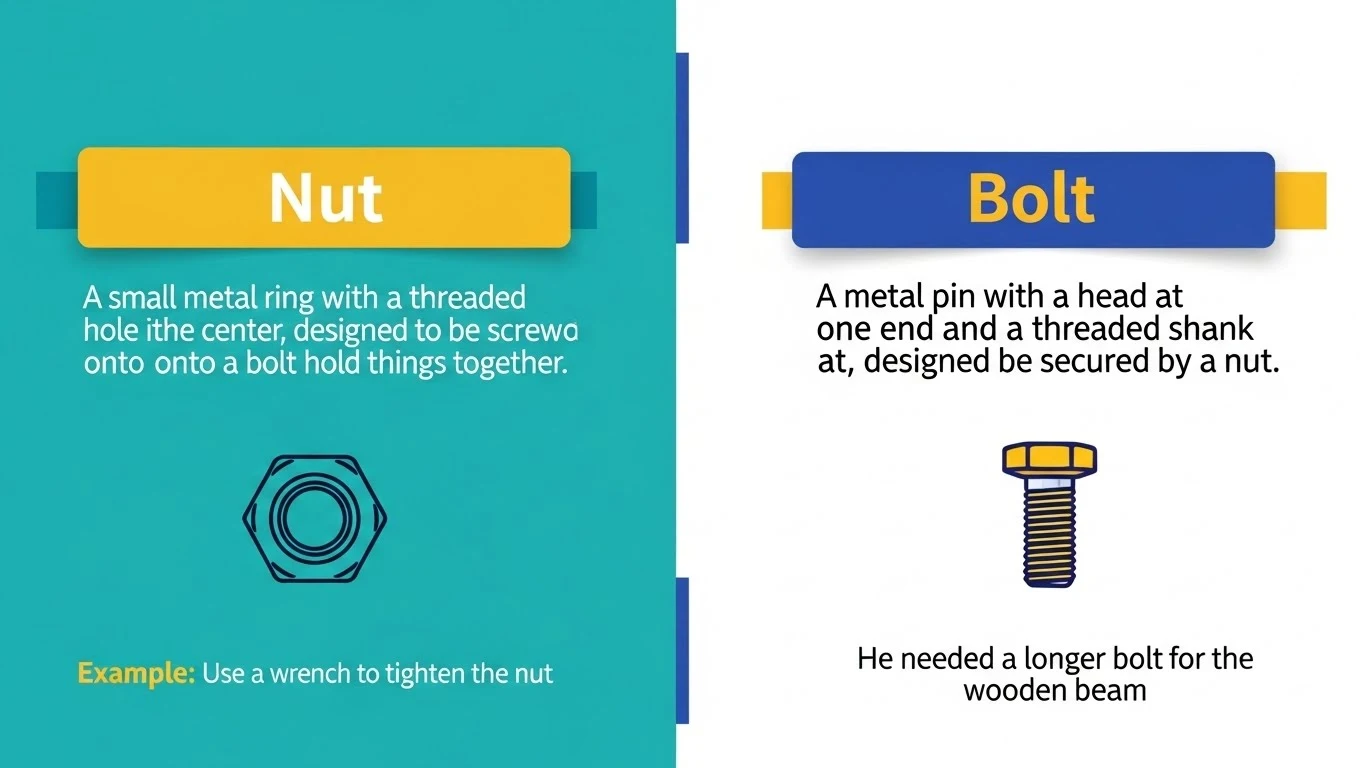
A bolt is a threaded metal pin. A nut is the piece that screws onto it.
- Bolt: long metal fastener with threads
Example: Insert the bolt through the hole. - Nut: small block or ring with threads inside
Example: Tighten the nut onto the bolt.
Simple rule: The bolt goes in. The nut tightens it.
The Origin of Nut or Bolt
The word nut comes from Old English hnutu. It was first used for hard-shelled fruits. Later, the name was used for small metal pieces with a hard shape.
The word bolt comes from Old English bolt, meaning a short arrow or shaft. Over time, it came to mean a metal pin used to fasten things together.
There are no spelling differences here. The confusion is about meaning, not spelling.
British English vs American English Spelling
There is no spelling difference between British and American English.
| Term | British English | American English | Example |
| nut | nut | nut | Tighten the nut |
| bolt | bolt | bolt | Insert the bolt |
Both varieties use the same words and meanings.
learn about: Says or Sais: Which Spelling Is Correct and Why It Matters
Which Spelling Should You Use?
Spelling is not the issue. Word choice is.
- Use bolt when you mean the long threaded fastener
- Use nut when you mean the piece that screws on
- For global audiences, be clear and specific
If both are needed, name both.
Common Mistakes with Nut or Bolt
Here are frequent errors and fixes:
- ❌ Tighten the bolt onto the rod.
✅ Tighten the nut onto the bolt. - ❌ Missing a nut or bolt (unclear)
✅ Missing a nut and bolt set - ❌ Using one word for both
✅ Name each part clearly
Nut or Bolt in Everyday Examples
Emails:
- Please include the nut and bolt with the package.
News:
- A loose bolt caused the delay.
Social Media:
- Lost a nut or bolt during the build 😅
Formal Writing:
- Each joint requires one bolt and one nut.
Nut or Bolt – Google Trends & Usage Data
Search data shows “nut or bolt” is common among DIY users, students, and engineers. Searches often spike during home projects and repair seasons.
Online usage shows bolt appears more in manuals and instructions, while nut often appears when parts are missing or listed together. The keyword is usually searched to understand the difference, not spelling.
Comparison Table: Keyword Variations
| Term | Function | Used Alone? | Used Together? |
| nut | Tightens | Yes | Yes |
| bolt | Inserts | Yes | Yes |
| nut and bolt | Fastens | No | Yes |
FAQs
1. Is a nut the same as a bolt?
No. They are different parts.
2. Can a bolt work without a nut?
Sometimes, if it screws into metal.
3. Is there a spelling difference in UK vs US English?
No.
4. Which comes first, nut or bolt?
The bolt goes in first.
5. Are screws the same as bolts?
No. Screws usually do not need nuts.
6. Why are they often mentioned together?
Because they work as a pair.
7. Is “nut or bolt” correct grammar?
Yes, when offering a choice.
Conclusion
The choice between nut or bolt is about function, not spelling. A bolt is the long threaded fastener. A nut is the piece that tightens onto it. They often work together, which is why people confuse them, but they are not the same thing.
There is no difference between British and American English, and no tricky spelling rules to remember. The key is clarity. Use the right word for the right part, especially in instructions, orders, and professional writing.
If you remember one thing, remember this: the bolt holds, the nut secures. With that simple rule, you will always know whether to use .

Robert Tressell is the pen name of Robert Noonan, a British–Irish novelist and political writer. He is best known for the novel The Ragged-Trousered Philanthropists, which presents a strong depiction of working-class life and social inequality. His work remains influential in English literature and social thought.