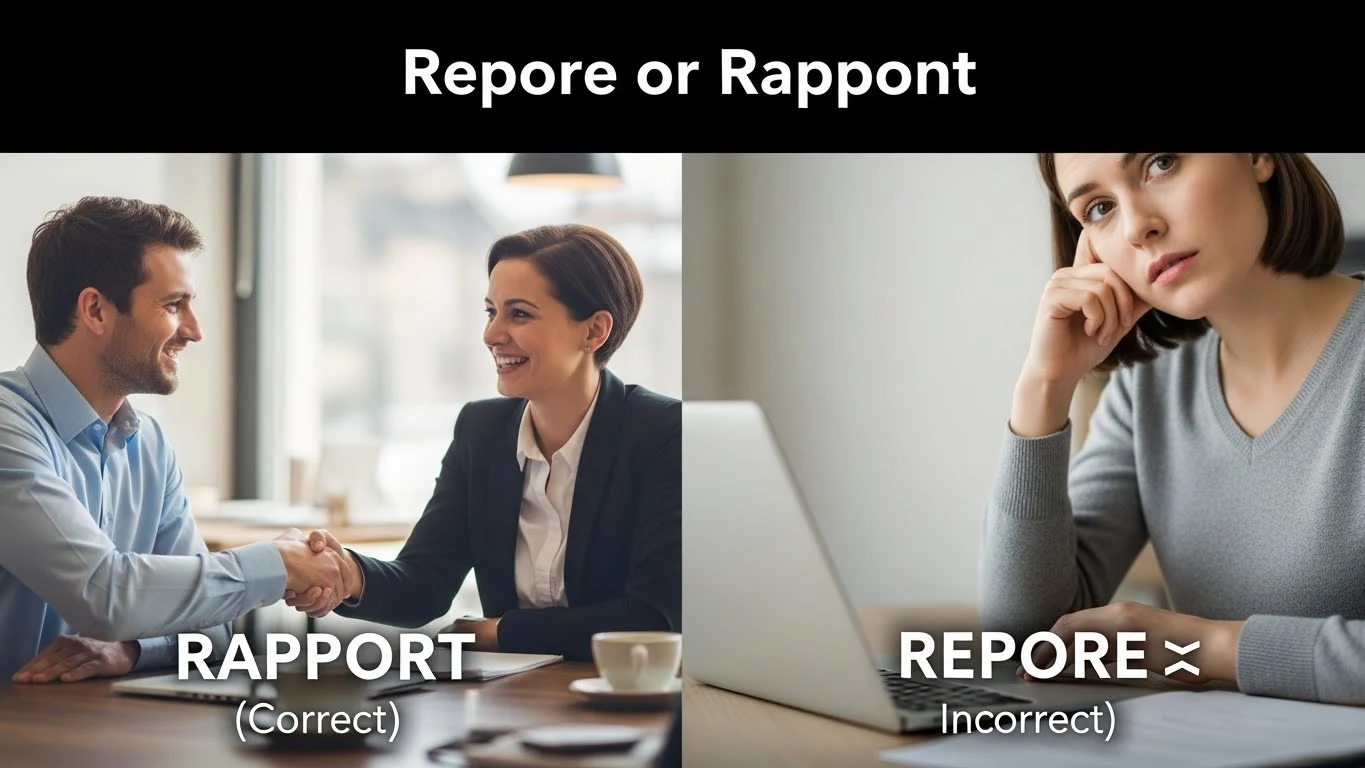
Have you ever typed “repore” and watched your spellchecker light up with a red underline? Or maybe you have read a sentence like “We need to build repore with clients” and paused, wondering if it looked right. If so, you are not alone.
Thousands of people search for “repore or rapport” every month because the correct word sounds very different from how it is spelled.
This confusion happens because rapport is pronounced ra-POUR, which leads many writers to spell it phonetically as repore. English is full of words borrowed from other languages, and rapport is one of them.
The mismatch between sound and spelling causes frequent mistakes in emails, resumes, LinkedIn profiles, academic writing, and business communication.
The issue matters more than it seems. Rapport is closely connected to ideas like trust, understanding, connection, and communication. When you misspell such an important word, it can quietly damage your credibility—especially in professional fields like business, psychology, sales, education, and leadership.
Repore or Rapport – Quick Answer
“Rapport” is correct. “Repore” is incorrect.
- Rapport = trust, mutual understanding, connection
Example: She quickly built strong rapport with her team. - Repore = not a real English word
Example: ❌ We must build repore with clients.
There is no situation—formal or informal—where repore is acceptable. Always use rapport in both writing and speech.
The Origin of Repore or Rapport
The word rapport comes directly from French. In French, rapport means relationship, harmony, or connection. It is derived from the verb rapporter, meaning to bring back or to relate. When English adopted the word in the early 19th century, it kept the original French spelling.
Rapport first became popular in fields like psychology, diplomacy, and counseling, where trust and emotional connection are essential. Over time, it spread into everyday language, especially in business, teaching, healthcare, and leadership contexts.
The spelling repore exists only because of pronunciation. Since rapport is pronounced ra-POUR, many learners—especially non-native English speakers—assume the spelling should match the sound. However, English often preserves foreign spellings, which is why this mistake is so common.
British English vs American English Spelling
Unlike many English words, there is no spelling difference between British and American English here.
| Word | British English | American English | Correct |
| rapport | yes | yes | ✅ |
| repore | no | no | ❌ |
Whether you are writing for a UK audience, a US audience, or a global one, rapport is always the correct spelling.
Which Spelling Should You Use?
The rule is simple and universal:
- US audience: Rapport
- UK / Commonwealth audience: Rapport
- Academic or professional writing: Rapport
- Casual or social writing: Rapport
There is never a context where repore is correct. If your goal is clarity and professionalism, rapport is the only option.
Common Mistakes with Repore or Rapport
Here are some of the most frequent errors people make, along with the correct versions:
- ❌ We need to build repore with our clients.
✅ We need to build rapport with our clients. - ❌ She has excellent repore skills.
✅ She has excellent rapport skills. - ❌ The teacher created good repore with students.
✅ The teacher created good rapport with students.
Most mistakes come from phonetic spelling. The solution is simple: trust the dictionary spelling, not the sound.
Repore or Rapport in Everyday Examples
Understanding how rapport is used in real life helps reinforce the correct spelling.
Emails:
I look forward to building strong rapport with the new team.
Business & Sales:
Successful salespeople focus on creating rapport before pitching.
Psychology & Counseling:
Therapists work hard to establish rapport with their clients.
News & Media:
The candidate built instant rapport with voters.
Social Media:
Great energy, great conversation, instant rapport 😊
Across all contexts, only rapport appears in published, edited English.
Repore or Rapport – Google Trends & Usage Data
Search behavior shows that “repore or rapport” is a surprisingly common query worldwide. Most searches come from:
- Students
- Job seekers
- Professionals writing emails or resumes
- Non-native English speakers
In books, news articles, academic journals, and professional websites, rapport appears frequently—especially in HR, psychology, education, leadership, and communication fields. Repore, on the other hand, appears only as a misspelling in drafts, forums, or informal posts.
This makes rapport a word worth mastering if you want to sound fluent and confident.
Comparison Table: Keyword Variations
| Term | Correct | Meaning | Use Case |
| rapport | ✅ Yes | trust, connection | formal & informal |
| repore | ❌ No | none | never |
FAQs
1. Is repore a real word?
No. It is always incorrect and not found in dictionaries.
2. Why does rapport look so unusual?
Because English kept its original French spelling.
3. How do you pronounce rapport?
It sounds like ra-POUR.
4. Is rapport formal or informal?
It works well in both professional and casual writing.
5. Can rapport be plural?
It is usually uncountable, though rare plural uses exist in technical contexts.
6. Is rapport commonly used in psychology?
Yes. It is a core concept in therapy and counseling.
7. Will spellcheck catch “repore”?
Most modern tools will flag it as incorrect.
Describe more: Amount or Ammount: Which Spelling Is Correct ?
Conclusion
The choice between repore or rapport becomes easy once you understand the facts. Rapport is the only correct spelling. Repore is simply a phonetic mistake caused by pronunciation differences. There is no British or American variation, and no professional or casual context where repore is acceptable.
Using the correct spelling matters because rapport itself is about trust and connection. Misspelling it can quietly undermine the very message you are trying to convey—especially in emails, resumes, reports, academic papers, and client communication.
Remember this simple rule:
If you are talking about trust, understanding, or a positive relationship between people, the word is rapport. Keep that in mind, and you will never hesitate again.

Robert Tressell is the pen name of Robert Noonan, a British–Irish novelist and political writer. He is best known for the novel The Ragged-Trousered Philanthropists, which presents a strong depiction of working-class life and social inequality. His work remains influential in English literature and social thought.