Many English learners and writers search for “tacet or tacit” because these two words look almost the same but mean very different things. One missing letter can change the whole meaning of a sentence. This confusion often appears in emails, academic writing, music-related texts, and formal discussions. People want a quick answer, but they also want to know why the words are different and how to use them correctly.
The problem is simple: tacet and tacit come from Latin, sound similar, and appear in formal contexts. But they belong to different worlds. One is mostly used in music. The other is common in everyday and professional English. Mixing them up can make your writing look careless or confusing, especially in exams, business emails, or published content.
This article solves that confusion clearly and quickly. You will get a short answer, real examples, history, spelling guidance for US and UK audiences, and practical advice. By the end, you will know exactly when to use tacet and when to use tacit, without guessing.
Tacet or Tacit – Quick Answer
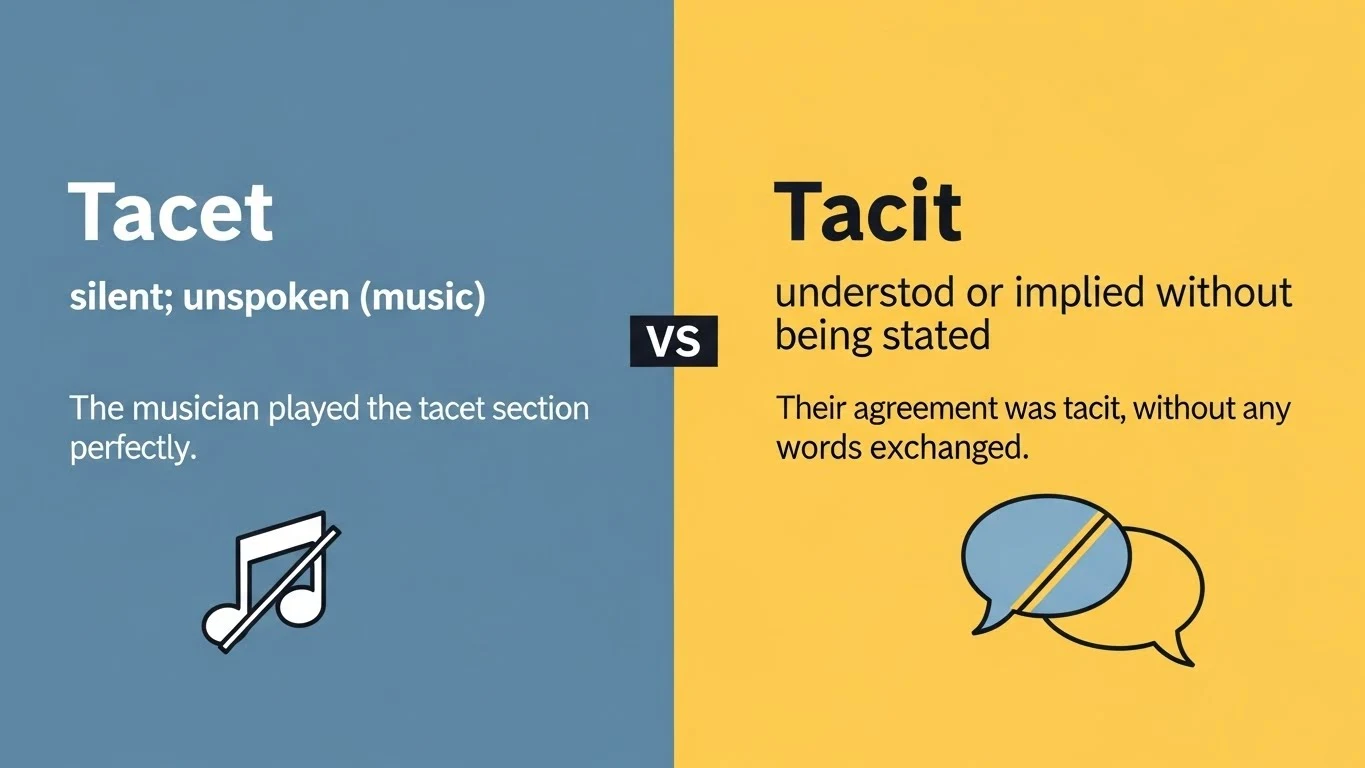
Tacet means silent and is mainly used in music.
Tacit means understood without being said and is used in general English.
Examples:
- The violin is tacet in this movement.
- There was tacit agreement among the team.
Simple rule:
If it’s about music, use tacet.
If it’s about unspoken understanding, use tacit.
learn more about: Forgive or Forget: What It Really Means and When to Use Each
The Origin of Tacet or Tacit
Both words come from Latin, which explains why they look alike.
- Tacet comes from Latin tacere, meaning “to be silent.”
It entered English through musical notation and stayed there. - Tacit comes from Latin tacitus, meaning “silent” or “unspoken.”
Over time, English writers used it to describe ideas or agreements not said out loud.
The spelling difference exists because English borrowed the words for different purposes. One stayed technical (music). The other became general and abstract.
British English vs American English Spelling
There is no spelling difference between British and American English for these words. Both regions use the same spellings and meanings.
| Aspect | Tacet | Tacit |
| US English | Tacet (music) | Tacit (general) |
| UK English | Tacet (music) | Tacit (general) |
| Meaning change | No | No |
The confusion is about meaning, not regional spelling.
Which Spelling Should You Use?
Your choice depends on context, not location.
- US audience:
Use tacit in business, law, and daily writing.
Use tacet only in music contexts. - UK / Commonwealth audience:
Same rule applies. No difference. - Global or ESL audience:
Avoid tacet unless you are writing about music.
Tacit is far more common and widely understood.
Tip: If you are unsure, tacit is usually the correct choice.
Common Mistakes with Tacet or Tacit
Here are frequent errors and fixes:
- ❌ There was tacet approval from the manager.
✅ There was tacit approval from the manager. - ❌ The orchestra had tacit during the second act.
✅ The orchestra was tacet during the second act. - ❌ Using tacet in emails or essays
✅ Use tacit instead
Remember:
Tacet = music only.
Tacit = people, ideas, agreements.
Tacet or Tacit in Everyday Examples
Emails:
- She gave tacit approval to proceed.
News:
- The policy change had tacit support from lawmakers.
Social Media:
- Silence can mean tacit agreement.
Formal Writing:
- Tacit consent plays a role in contract law.
Music Writing:
- The flute is tacet for eight measures.
Tacet or Tacit – Google Trends & Usage Data
Search data shows that “tacit” is far more popular worldwide. It appears often in:
- Business writing
- Legal texts
- Academic articles
- News reports
“Tacet” has very low search volume and is mostly used by:
- Musicians
- Music students
- Sheet music readers
By country:
- US, UK, Canada, Australia → Tacit dominates
- Music-related searches → Tacet appears occasionally
This shows that most users searching “tacet or tacit” want help avoiding mistakes.
Comparison Table: Tacet vs Tacit
| Feature | Tacet | Tacit |
| Part of speech | Adjective | Adjective |
| Main use | Music | General English |
| Meaning | Silent | Unspoken |
| Commonness | Rare | Very common |
| Used in emails | No | Yes |
| Used in music | Yes | No |
FAQs About Tacet or Tacit
1. Are tacet and tacit interchangeable?
No. They have different meanings and uses.
2. Is tacet used outside music?
Almost never. It is a musical term.
3. Does tacit mean silent?
It means understood without words, not physically silent.
4. Can I use tacet in an essay?
Only if the essay is about music.
5. Is tacit formal English?
Yes, but it is common in professional writing.
6. Which word appears more in dictionaries?
Both do, but tacit appears far more often in examples.
7. How can I remember the difference?
Think “T in tacet = tune” (music).
Conclusion
The confusion between tacet or tacit is common, but the solution is simple once you understand context. These words look similar because they share Latin roots, but English gave them different jobs. Tacet stayed in the world of music, where it signals silence in a performance. Tacit moved into everyday language, where it describes ideas, agreements, or understanding that are not spoken aloud.
For most writers, students, and professionals, tacit is the word you need. It fits emails, reports, news articles, and academic writing. Tacet is rare and should only appear when you are talking about musical scores or orchestras. Using the wrong word can confuse readers and weaken your message.
If you remember one thing, remember this:
Music = tacet. People and ideas = tacit.
This simple rule will help you write with confidence and clarity every time.

I am Olga Tokarczuk, a Polish novelist and essayist whose work is widely studied for its rich vocabulary, precise language, and literary expression. My writings are often referenced in academic and linguistic contexts for their clarity of diction and thoughtful use of words. I am a prominent figure in modern world literature.