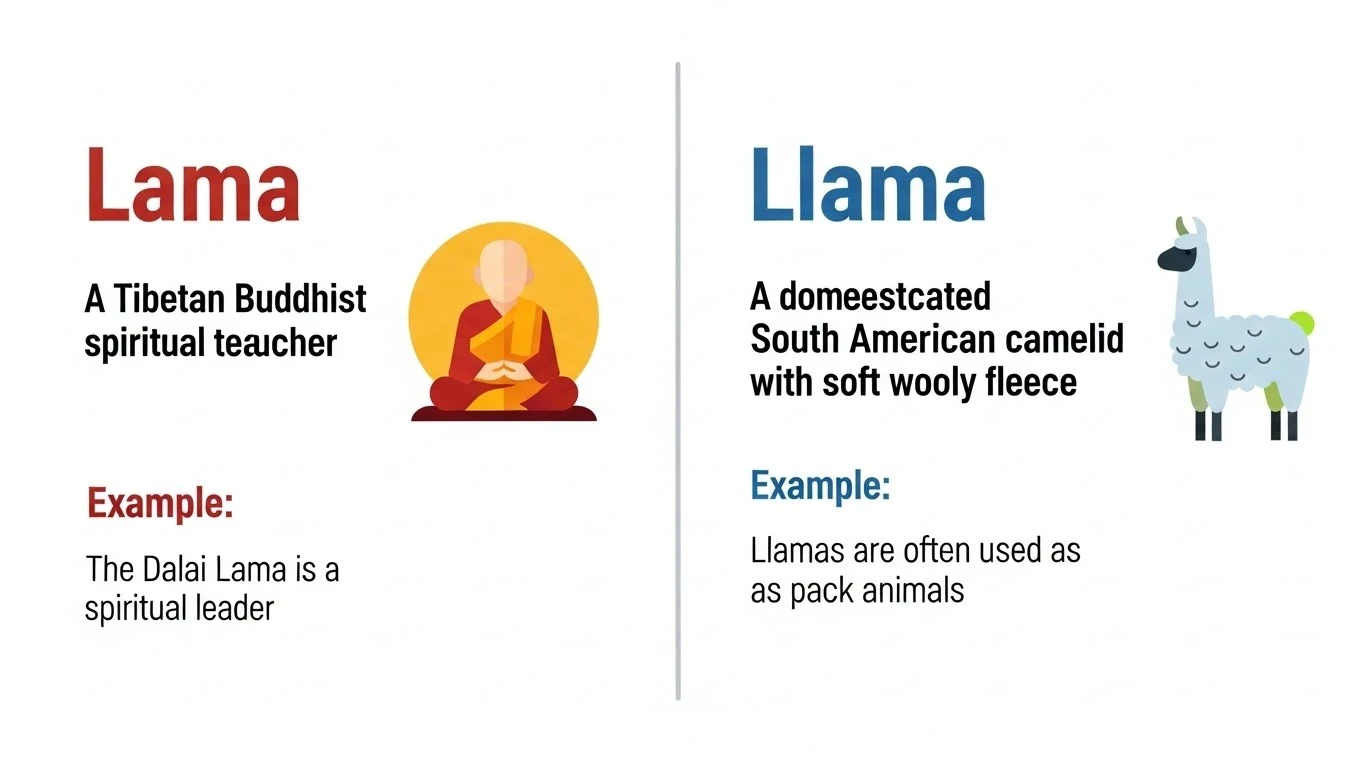
The words lama or llama look almost identical, but they represent two completely different things. This small spelling difference causes big confusion for students, writers, travelers, and English learners.
People often search for lama or llama when writing school assignments, travel blogs, religious articles, or social media posts. They want to be sure they are using the correct word and not accidentally changing the meaning of their sentence.
The confusion mainly comes from pronunciation and spelling. Many English speakers pronounce both words in a similar way. Because of this, it is easy to mix them up in writing.
However, the meanings could not be more different. One word refers to a spiritual teacher in Buddhism, while the other refers to a South American animal. A single extra “l” can turn a sentence from religious to zoological in seconds.
Spellcheck tools do not always help because both words are correct English words. That is why this confusion keeps appearing in essays, articles, captions, and even news reports. Knowing the difference is important for clarity and professionalism.
Lama or Llama – Quick Answer
Lama = a Buddhist spiritual teacher
Example: The lama guided the students during meditation.
Llama = a South American animal
Example: The llama grazed peacefully in the field.
Simple rule to remember:
- Religion or spirituality → lama
- Animal or nature → llama
If you remember this one rule, you will always choose the correct word.
learn about: Comptroller or Controller: What’s the Difference ?
The Origin of Lama or Llama
Understanding where these words come from makes the difference even clearer.
Origin of Lama
The word lama comes from Tibetan Buddhism. It refers to a respected spiritual teacher, guide, or leader. In Tibetan culture, a lama is someone who has deep spiritual knowledge and authority. The Dalai Lama is the most well-known example.
Origin of Llama
The word llama comes from Spanish, which borrowed it from native Andean languages such as Quechua. It refers to a domesticated animal found in South America, especially in countries like Peru, Bolivia, and Chile. Llamas have been used for transportation, wool, and farming for thousands of years.
These words look similar only because English borrowed them from different cultures. Their spellings are fixed and intentional.
British English vs American English Usage
There is no regional spelling difference for lama or llama. Both words are spelled the same in British English and American English, and their meanings do not change.
| Word | British English | American English |
| lama | religious teacher | religious teacher |
| llama | animal | animal |
This makes things easier because you do not need to worry about country-based spelling rules.
Which Spelling Should You Use?
Choosing the correct word depends entirely on meaning, not location or style.
- Writing about Buddhism, monks, or spiritual teaching → lama
- Writing about animals, farms, or travel → llama
- Academic or cultural writing → double-check meaning
- Social media or casual writing → still follow the same rule
There is never a situation where one word replaces the other.
Common Mistakes with Lama or Llama
Many writers make the same mistakes again and again. Here is how to avoid them.
❌ Calling the animal a lama
✅ Correct: Use llama
❌ Referring to a monk as a llama
✅ Correct: Use lama
❌ Assuming spelling changes by country
✅ Correct: Spelling stays the same worldwide
❌ Trusting pronunciation alone
✅ Correct: Focus on meaning, not sound
❌ Letting spellcheck decide
✅ Correct: Spellcheck cannot tell meaning
Lama or Llama in Everyday Examples
Seeing the words in context makes them easier to remember.
- Email: The lama will visit the temple this weekend.
- News article: The zoo welcomed a newborn llama.
- Social media: Look at this fluffy llama!
- Travel blog: We saw llamas while hiking in Peru.
- Academic writing: The lama plays a key role in Buddhist education.
- Children’s book: The llama carried supplies through the mountains.
Each example shows how different the meanings truly are.
Lama or Llama – Google Trends & Usage Data
Search trends show that llama is searched far more often than lama. This is because llamas are popular in travel content, memes, children’s books, and viral videos. Searches spike during tourism seasons and cultural events in South America.
The word lama appears less frequently but remains important in academic, religious, and cultural searches. Interest increases during Buddhist festivals, teachings, and discussions about spirituality.
Despite the difference in popularity, both words are essential in their correct contexts.
Lama vs Llama: Side-by-Side Comparison
| Word | Meaning | Common Context |
| lama | spiritual teacher | religion, Buddhism |
| llama | animal | nature, farming, travel |
This table clearly shows why mixing them up creates confusion.
FAQs About Lama or Llama
1. Is lama an animal?
No. Llama is the animal.
2. Is llama a religious term?
No. Lama refers to a spiritual teacher.
3. Are lama and llama pronounced the same?
They can sound similar, but they mean different things.
4. Does spelling change by country?
No. The spelling stays the same everywhere.
5. Can spellcheck catch this mistake?
Not always, because both words are correct.
6. Which word is more common?
Llama is more common in everyday searches.
7. Can both words be plural?
Yes. The plurals are lamas and llamas.
Conclusion
The difference between lama or llama is simple once you understand it. A lama is a Buddhist spiritual teacher. A llama is a South American animal. These are not spelling variations of the same word. They are two completely different words with different histories, meanings, and uses.
The confusion happens because the words look and sound similar, but using the wrong one can quickly confuse readers. In academic writing, professional content, and online communication, accuracy matters. One extra “l” can change your message entirely.
Whenever you feel unsure, pause and think about context. Are you writing about religion, meditation, or spiritual guidance? Choose lama. Are you writing about animals, travel, farms, or nature? Choose llama. With this simple rule, you will always get it right.

Robert Tressell is the pen name of Robert Noonan, a British–Irish novelist and political writer. He is best known for the novel The Ragged-Trousered Philanthropists, which presents a strong depiction of working-class life and social inequality. His work remains influential in English literature and social thought.