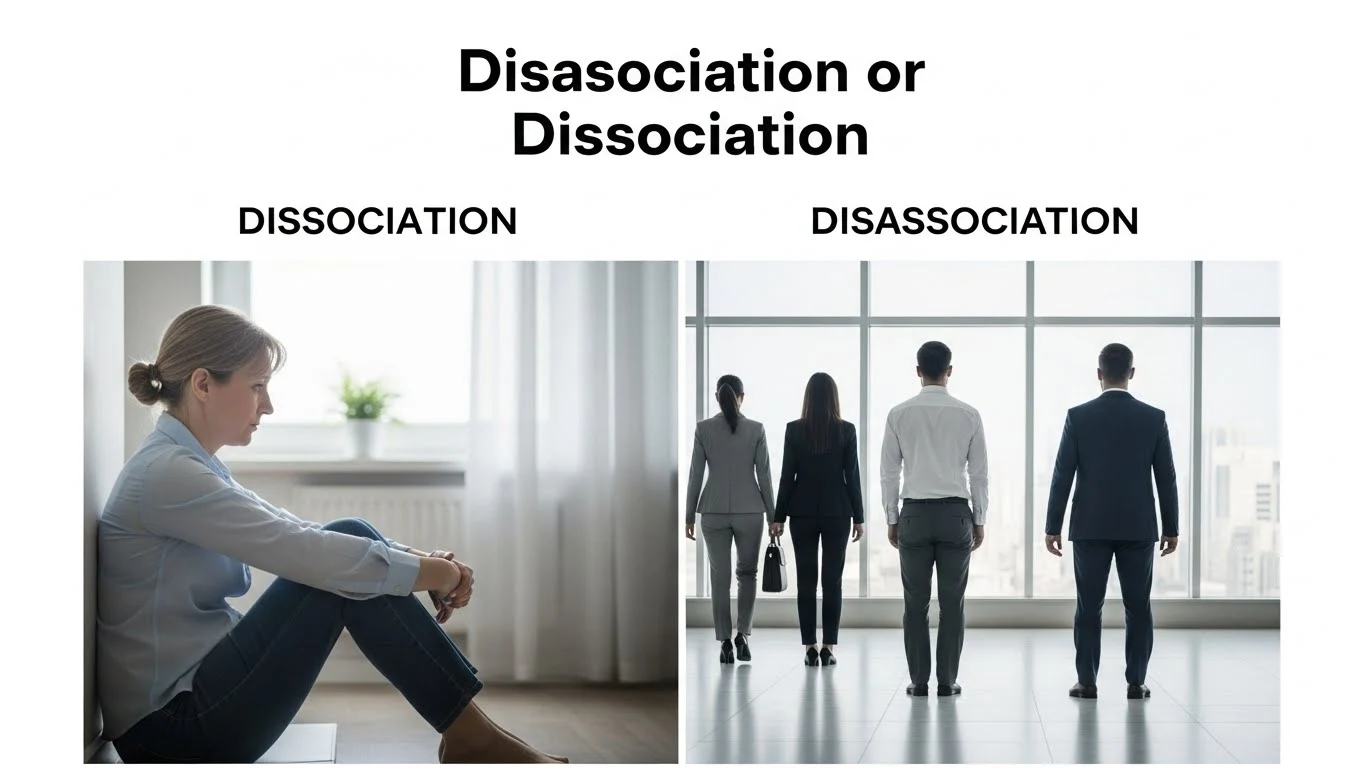
The words disassociation and dissociation look almost identical at first glance. The difference is just a few letters, yet this small spelling change creates major confusion for writers. Many people search for “disassociation or dissociation” when writing essays, psychology papers, business reports, legal documents, or formal emails. They want to know which word is correct and which one sounds professional.
The confusion exists because both words technically exist, both come from the same root, and both relate to the idea of separation. To make things harder, spellcheck tools often accept both spellings, which gives writers false confidence. However, in modern English, these words are not equal in usage or clarity.
One term is widely accepted, precise, and used across psychology, medicine, business, and everyday language. The other is rare, often unnecessary, and frequently misused. In psychology, choosing the wrong word can sound incorrect. In legal or business writing, it can make your sentence feel awkward or outdated.
This article clears up the confusion step by step. First, you will get a quick and clear answer. Then you will learn about the origin of both words, how British and American English treat them, where each word is used, common mistakes people make, and how to choose the right spelling in real-life writing. By the end, you will know exactly which word to use and why.
Disassociation or Dissociation – Quick Answer
Dissociation = separation or detachment (correct and common)
Example: She experienced dissociation during extreme stress.
Disassociation = an uncommon and often unnecessary form
Example: The group announced its disassociation from the event.
Simple rule:
👉 Use dissociation in almost all cases.
If you remember only one thing from this article, remember this rule.
The Origin of Disassociation or Dissociation
Both words come from the Latin verb dissociare, which means “to separate” or “to disconnect.” From this root, English formed the noun dissociation, which became the standard term.
Over time, some writers added an extra prefix dis-, forming disassociation. While this form is not grammatically illegal, it created a longer and less efficient word without adding new meaning.
Language naturally favors clarity and simplicity. Because dissociation already clearly expressed separation, it became the preferred form in dictionaries, academic writing, and professional usage. As a result, disassociation slowly faded from common use.
Today, dissociation dominates modern English, while disassociation survives mainly in limited or formal contexts.
British English vs American English Spelling
Many spelling debates depend on regional differences, such as colour vs color or organise vs organize. However, this is not one of those cases.
There is no meaningful difference between British and American English here.
| Term | British English | American English |
| dissociation | very common | very common |
| disassociation | rare | rare |
Both varieties strongly prefer dissociation. Usage preference matters far more than regional spelling.
Which Spelling Should You Use?
Here is clear guidance based on context:
- Academic writing: Use dissociation
- Psychology or medical writing: Use dissociation
- Business communication: Use dissociation
- Legal or policy writing: Use dissociation
- Global or online audience: Use dissociation
When can you use disassociation?
Only use it if:
- It appears in an official name
- You are quoting a legal or organizational statement
- You must match existing wording exactly
In original writing, dissociation is almost always the better choice.
Common Mistakes with Disassociation or Dissociation
Writers often make the same errors with these words. Here are the most common ones:
❌ Using disassociation for mental or emotional states
✅ Use dissociation
❌ Assuming both words are equally correct
✅ Dissociation is standard; disassociation is rare
❌ Adding extra prefixes for clarity
✅ Shorter, established forms are clearer
❌ Ignoring dictionary and professional usage
✅ Follow modern, accepted standards
Avoiding these mistakes will instantly improve the clarity and credibility of your writing.
Disassociation or Dissociation in Everyday Examples
Seeing the words in real sentences makes the difference clearer:
- Email: The company stated its dissociation from the claim.
- News: Experts discussed trauma-related dissociation.
- Social media: I felt dissociation during the meeting.
- Formal writing: Dissociation is a recognized psychological process.
- Policy statement: The board announced dissociation from past actions.
Notice how dissociation fits naturally in all these contexts.
Disassociation or Dissociation – Google Trends & Usage Data
Search data strongly supports modern usage rules. Dissociation is searched far more frequently worldwide. It appears most often in:
- Health and mental health topics
- Psychology education
- Academic research
- Workplace and stress-related discussions
Disassociation, by contrast, shows:
- Low search volume
- Declining interest
- Mostly legal or organizational usage
This confirms that dissociation is the dominant and preferred term in real-world language.
Disassociation vs Dissociation: Comparison Table
| Word | Meaning | Common Use |
| dissociation | separation or detachment | very high |
| disassociation | formal separation (rare) | low |
FAQs About Disassociation or Dissociation
1. Are disassociation and dissociation the same?
No. Dissociation is the standard and preferred word.
2. Is disassociation incorrect?
Not completely wrong, but often unnecessary and unclear.
3. Which term do psychologists use?
Dissociation.
4. Is disassociation outdated?
Mostly, yes.
5. Can I use dissociation in business writing?
Yes, it is clear and professional.
6. Which word is clearer for readers?
Dissociation.
7. Should I avoid disassociation?
In most cases, yes.
Discover more : Winner or Winer: Which Spelling Is Correct ?
Conclusion
The choice between disassociation or dissociation is simpler than it first appears. Dissociation is the correct, preferred, and widely accepted word in modern English. It clearly expresses separation, detachment, or mental distance and is used confidently across psychology, medicine, business, and everyday communication.
Disassociation does exist, but it is rare and often causes confusion. In most situations, it adds no clarity and may even make your writing sound outdated or awkward. Unless you are quoting an official title or fixed phrase, there is little reason to use it.
If you want your writing to sound professional, clear, and current, choose dissociation. This choice aligns with dictionaries, experts, and global usage trends. Once you follow this rule, you will avoid a common language mistake and write with confidence.

Olga Tokarczuk is a Polish novelist and essayist whose work is widely studied for its rich vocabulary, precise language, and literary expression. Her writings are often referenced in academic and linguistic contexts for their clarity of diction and thoughtful use of words. She is a prominent figure in modern world literature.