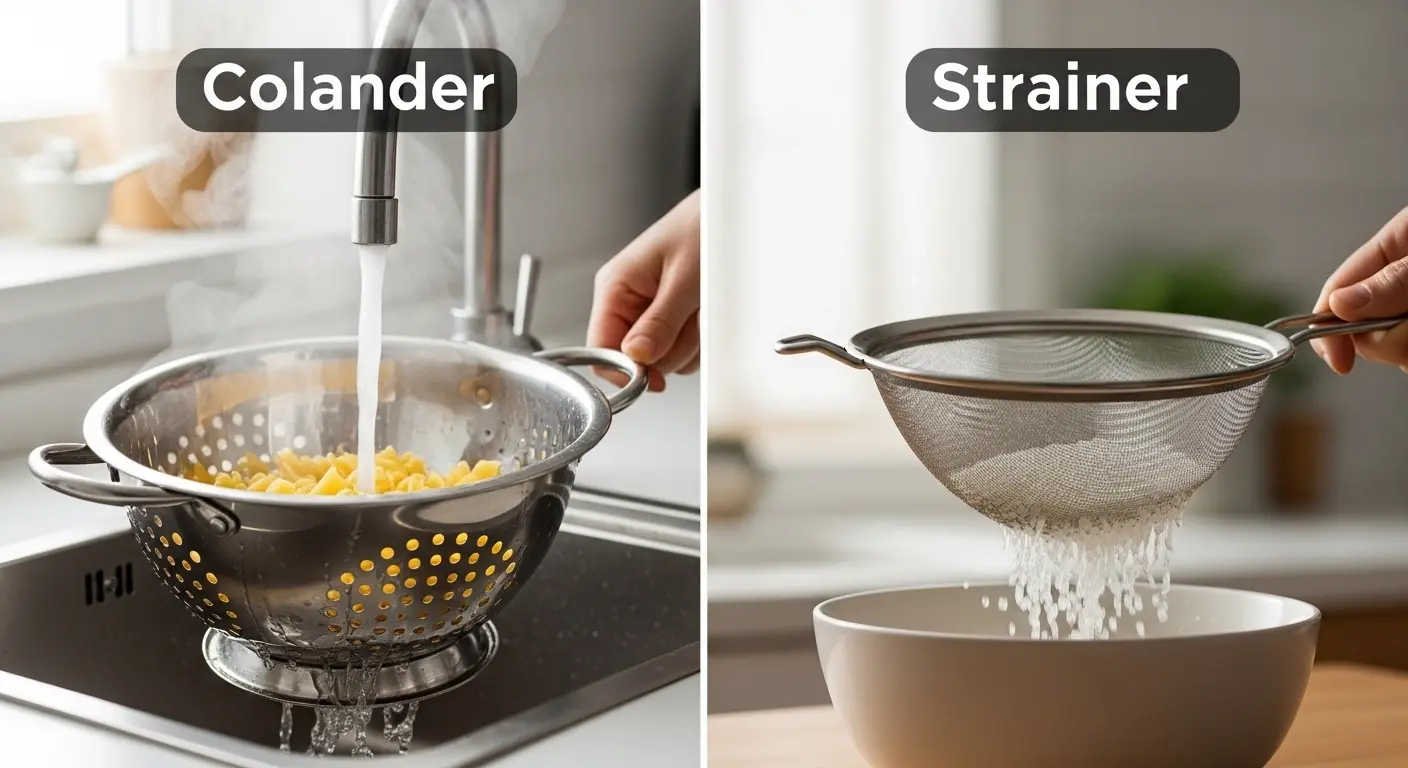
A colander works best for draining large foods like pasta or vegetables, while a strainer suits fine tasks such as filtering tea or sauces.
Many people search for “colander or strainer” because these two kitchen tools look similar and often perform related tasks.
As a result, when you cook pasta, wash rice, or strain soup, you may pause and ask yourself: Is this a colander or a strainer? Because people frequently use the terms interchangeably, confusion naturally grows.
Therefore, this article solves a simple but common problem. You may want to name the correct tool while writing a recipe, shopping online, or explaining a cooking step in an email or blog. In those situations, using the wrong word can sound unclear or unprofessional.
To help you, this guide gives a clear answer first. Then, it explains the real difference, the origin of both words, and how usage can vary by region. By the end, you will know exactly which term to use, when to use it, and why the choice matters.
Colander or Strainer – Quick Answer
A colander is a bowl-shaped kitchen tool with large holes. Cooks use it to drain foods such as pasta, potatoes, or vegetables quickly.
In contrast, a strainer contains small holes or fine mesh. People use it to strain liquids, tea leaves, sauces, or small grains.
Examples:
- Drain pasta → Colander
- Strain tea → Strainer
- Wash vegetables → Colander
- Remove seeds from juice → Strainer
The Origin of Colander or Strainer
The word colander comes from the Latin term colum, which means “sieve.” It entered English through French and has appeared in cooking contexts for centuries.
Meanwhile, the word strainer comes from the verb strain, meaning to separate liquid from solids. It traces back to Old French and Middle English.
Because cooks designed these tools for different purposes, the names developed separately. One handled heavy, solid foods, while the other focused on fine filtering. Over time, kitchens kept both tools, yet everyday speech slowly began to mix the terms.
British English vs American English Usage
Both British and American English use colander and strainer. However, usage preferences can vary slightly.
| Tool | American English | British English |
| Colander | Common | Common |
| Strainer | Very common | Very common |
| Mesh strainer | Widely used | Often called strainer |
In American English, people often say “mesh strainer.” In British English, speakers may simply say “strainer” for the same tool.
Which One Should You Use?
To choose correctly, focus on the task and your audience.
- US audience: Use colander for pasta and strainer for liquids.
- UK or Commonwealth audience: Follow the same rule, although “strainer” may cover more uses.
- Global audience: Use the specific word and add a brief description for clarity.
Tip: When precision matters, describe the tool directly:
“Use a fine strainer” or “Use a large colander.”
Common Mistakes with Colander or Strainer
Mistake 1: Calling every draining tool a strainer
✔ Correct: Use a colander for pasta and vegetables
Mistake 2: Using a colander for tea or sauces
✔ Correct: Use a strainer for liquids
Mistake 3: Mixing both terms in one recipe
✔ Correct: Choose one term and stay consistent
Mistake 4: Ignoring hole size
✔ Correct: Large holes mean colander; fine mesh means strainer
Colander or Strainer in Everyday Examples
Emails:
- “Please drain the pasta using a colander.”
Recipes:
- “Pour the sauce through a fine strainer.”
Social Media:
- “I forgot my colander, so I used a pan lid instead.”
Formal Writing:
- “The technician filtered the liquid using a stainless steel strainer.”
Colander or Strainer – Google Trends & Usage Data
Search trends show that strainer appears more often worldwide. This happens because people use the word in cooking, drinks, and even laboratory contexts.
However, colander attracts strong interest in food-related searches, especially pasta recipes.
By region:
- USA: Both terms show strong usage
- UK: “Strainer” appears slightly more often
- Global: “Strainer” leads due to broader meaning
Keyword Comparison Table
| Feature | Colander | Strainer |
| Hole size | Large | Small / mesh |
| Best for | Pasta, veggies | Tea, sauces |
| Shape | Bowl | Bowl or handle |
| Use frequency | Medium | High |
FAQs
1. Are colander and strainer the same? No. Each tool serves a different purpose.
2. Can I use a strainer instead of a colander?
Yes, but it may slow you down with large foods.
3. Is a sieve the same as a strainer?
Yes. A sieve is a type of strainer.
4. Which tool works best for rice?
A fine strainer works best.
5. Which word sounds more professional?
Both sound professional when used correctly.
6. Do chefs use both tools?
Yes. Professional kitchens rely on both.
7. Is colander used outside cooking?
Rarely. Strainer has broader applications.
Conclusion
Once you understand the difference between colander or strainer, the choice becomes easy. A colander handles large, solid foods and drains water quickly. Meanwhile, a strainer manages small particles and liquids with greater control. People often confuse the terms because both tools remove liquid, and casual speech blends their meanings.
For clear writing and confident communication, always match the word to the task. Consider hole size, food type, and audience. In recipes, blogs, or professional content, accuracy builds trust. For global readers, a short description can remove doubt.
When unsure, remember this simple rule: big food, big holes, colander; fine filtering, small holes, strainer. Choosing the right term improves clarity and makes cooking easier.
Learn more:
Knaw or Gnaw: Which Spelling Is Correct and When to Use It

I am Samuel Reedman, a digital English content creator who writes educational comparison posts for learners worldwide. My work emphasizes correct word usage, pronunciation differences, and practical examples for daily communication.