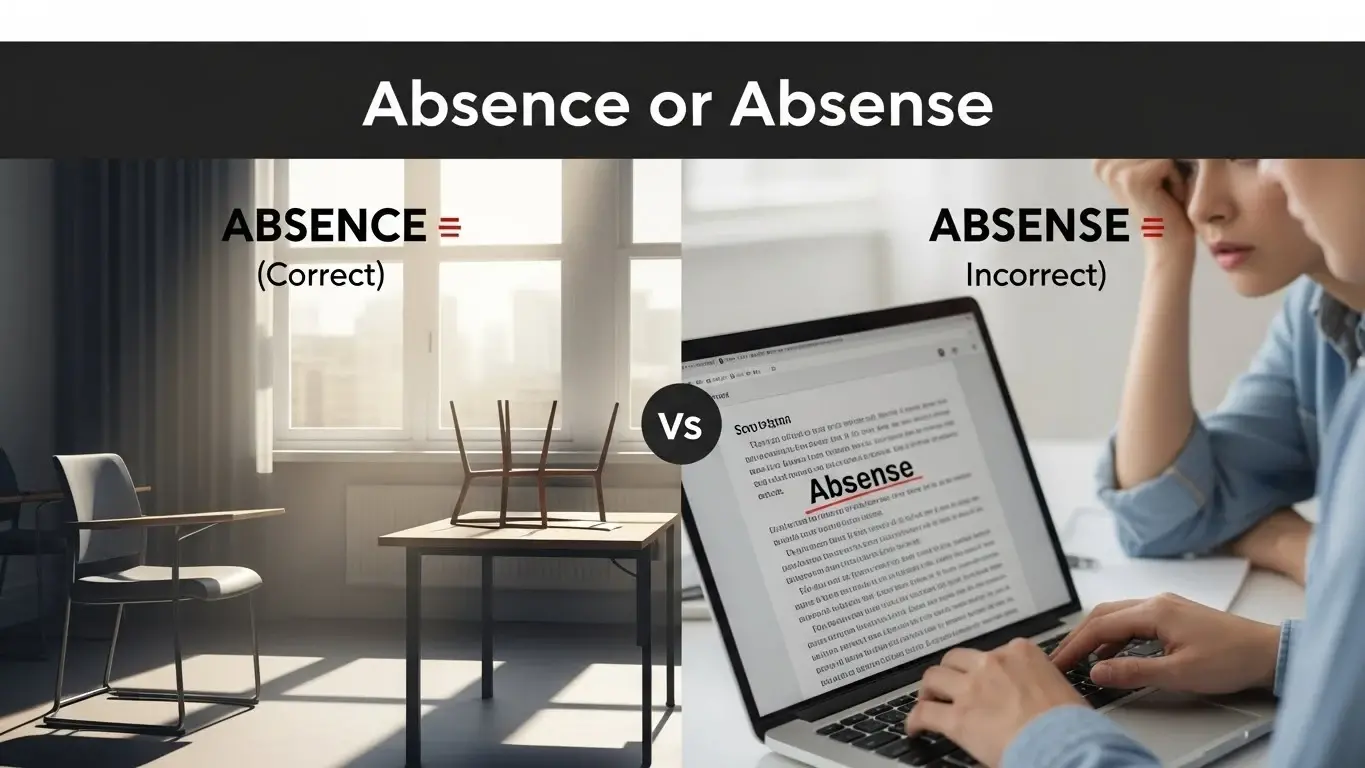
The correct spelling is absence. Absense is a common spelling mistake. Many people search for “absence or absense” because both words look similar and sound the same when spoken.
This small difference causes big confusion in emails, school essays, exams, office reports, and formal documents. When writing fast, people often type absense by habit.
Spellcheck does not always catch it, especially in casual messages, so the mistake spreads online and feels “normal.”
The confusion grows because English spelling is not always logical. The word absence comes from the root absent, but the spelling changes slightly.
Some writers even think absense might be an American version and absence a British one. That is not true. Both British and American English use absence as the only correct spelling.
Absence or Absense – Quick Answer
- Absence = ✅ correct spelling
Example: Her absence from the meeting was noticed. - Absense = ❌ incorrect spelling also abscence is wrong
Example: ❌ His absense was explained to the teacher.
Absence Meaning
Absence means not being present.
It is used when a person, thing, or quality is not there.
Examples:
- His absence was noticed in the meeting.
- The teacher marked her absence today.
- There was a long absence of rain this year.
Simple rule:
Always use absence. There are no exceptions.
The Origin of Absence or Absense
To understand why absence is correct, it helps to look at its history. Historically, the word absence comes from the Latin absentia, meaning “being away” or “not present.” Over time, English adopted this term and preserved its structure.
Importantly, absence follows a common English noun pattern ending in -ence. Similar examples include:
- presence
- difference
- silence
- patience
In contrast, absense has no historical root. It did not develop from Latin, French, or any recognized source. Instead, it exists only because of repeated misspelling. In short, absense is an error, not a real word.
British English vs American English Spelling
Another major source of confusion is regional spelling. Although English does have differences such as colour vs color or centre vs center, this is not one of those cases.
In fact, there is no regional variation here.
| Word | British English | American English |
| absence | correct | correct |
| absense | incorrect | incorrect |
Therefore, regardless of where you are writing or who your audience is, the correct spelling remains the same.
Which Spelling Should You Use?
The answer remains consistent in every context:
- Writing for a US audience → absence
- absense or absence uk or Commonwealth audience → absence
- Academic writing → absence
- Business or professional writing → absence
- Casual or online writing → absence
Simply put, there is no situation where absense is correct.
Why Is This Mistake So Common?
Even though the rule is simple, the mistake appears frequently. There are several reasons behind this pattern.
First, pronunciation plays a big role. When spoken aloud, absence sounds like it could contain sense, which pushes writers toward absense.
Second, many English words end in -sense, such as sense, nonsense, and commonsense. Because of this, writers wrongly apply that pattern here.
Finally, fast typing and over-reliance on autocorrect increase the problem. When proofreading is skipped, the error often slips through unnoticed.
Common Mistakes with absense vs absence
Here are the most frequent errors and how to fix them:
- ❌ Using absense because it “sounds right”
✅ Use absence - ❌ Trusting spellcheck without reviewing
✅ Proofread carefully - ❌ Assuming spelling changes by country
✅ Remember it does not - ❌ Mixing it up with -sense words
✅ Recall that absence ends in -ence
Absence or Absense in Everyday Examples
To see correct usage clearly, consider these examples:
- Email: Your absence from work yesterday was noted.
- News: The absence of evidence raised serious concerns.
- Social media: Feeling your absence today.
- Formal writing: Absence can negatively affect productivity.
- School note: Absence due to illness was approved.
In every case, absence is the only correct choice.
Absence or Absense – Google Trends & Usage Data
Search behavior also supports this rule. Overall, absence appears extremely frequently in normal usage worldwide. By contrast, searches for absense usually include phrases like “correct spelling” or “is absense wrong.”
This trend clearly shows that users are not choosing absense intentionally. Instead, they are checking whether it is incorrect.
Absence vs Absense: Comparison Table
| Word | Correct | Meaning |
| absence | yes | state of being away |
| absense | no | spelling error |
FAQs About Absence or Absense
- how do you spell absence?
Absence is correct spelling. - Why do people misspell absence?
Because of pronunciation and confusion with sense. - Is absence spelled the same everywhere?
Yes, in both British and American English. - Is absence a noun?
Yes. - Can absense appear in dictionaries?
No, it is not recognized. - How can I remember the spelling?
Link it with presence. - Does absence have a plural form?
Yes, absences.
Conclusion
Overall, the choice between absense or absence is straightforward. Absence is the correct and only accepted spelling in English. On the other hand, absense is a common mistake caused by pronunciation and habit.
Although spelling errors may seem minor, they can still affect clarity, professionalism, and credibility. In academic writing, business communication, and online content, correct spelling builds trust. For this reason, remembering that absence follows the same pattern as presence makes the spelling easy to recall.
Once this rule becomes clear, hesitation disappears. Use absence every time, and your writing will remain accurate, confident, and professional.
Learn more:
Repore or Rapport: Which Spelling Is Correct ?

I am Samuel Reedman, a digital English content creator who writes educational comparison posts for learners worldwide. My work emphasizes correct word usage, pronunciation differences, and practical examples for daily communication.