The phrase forgive or forget is one of the most commonly used expressions in English. You hear it in personal advice, therapy sessions, religious discussions, self-help books, relationship talks, and even workplace communication. At first glance, it sounds simple and comforting. But when people stop to think about it, the phrase raises many questions. Do you forgive first? Do you forget at all? Are forgiveness and forgetting the same thing, or are they completely different?
People search for forgive or forget because the phrase feels emotionally heavy and linguistically unclear. Some believe that forgiving someone means you must forget the harm they caused. Others think forgetting is dangerous because it may allow the same mistake to happen again. Writers and learners of English are also unsure how to use the phrase correctly in sentences. Is it advice, a command, or just a saying?
This article clears up that confusion. First, you will get a quick and clear answer. Then you will learn the origin of the phrase, how English uses it today, and how meaning matters more than spelling. You will also see common mistakes, real-life examples, and a clear comparison between forgive and forget. By the end, you will understand how to use forgive or forget correctly—in language, writing, and real life.
Forgive or Forget – Quick Answer
Forgive and forget are not the same thing.
- Forgive means to let go of anger, resentment, or blame toward someone.
Example: I forgive you for the mistake. - Forget means to lose the memory or no longer remember what happened.
Example: I forgot what happened last year.
Key Idea
You can forgive without forgetting.
Forgetting is not required for forgiveness.
This distinction is essential in both grammar and meaning.
learn about: Antipasto or Antipasta: Which Word Is Correct for Italian Starters?
The Origin of Forgive or Forget
Both words come from Old English, and their original meanings were already separate.
- Forgive comes from forgiefan, meaning to give up anger, cancel a debt, or stop blaming.
- Forget comes from forgietan, meaning to lose memory or fail to remember.
Historically, the phrase forgive and forget appeared in religious teachings, moral advice, and philosophical writing. It encouraged people to release anger and move forward peacefully. Over time, the phrase was shortened in speech to forgive or forget, which unintentionally caused confusion. The word or makes it sound like a choice, even though the original idea focused on forgiveness, not memory loss.
The spelling never changed, but the interpretation did.
Forgive or Forget in Modern English Usage
In modern English, forgive or forget is usually used as:
- Advice
- A reflective question
- A moral discussion point
It is not usually meant as a strict rule.
Examples:
- Should we forgive or forget after a public apology?
- The hardest part is learning to forgive without forgetting.
- Society struggles to forgive, but it never forgets.
The phrase often carries emotional or ethical meaning rather than grammatical complexity.
British English vs American English Spelling
There is no spelling difference between British and American English.
| Phrase | British English | American English |
|---|---|---|
| forgive or forget | same spelling | same spelling |
The difference is how people interpret the phrase, not how they spell it.
Which Usage Should You Choose in Writing?
- US audience: Use the phrase normally, but explain the meaning if needed.
- UK/Commonwealth: Same usage applies.
- Global or professional writing: Clarify whether you mean emotional forgiveness or memory loss.
In formal writing, avoid ambiguity:
- Instead of “forgive and forget,” write:
- “forgive, but remember the lesson.”
- “forgive emotionally without erasing memory.”
Clear language prevents misunderstanding.
Common Mistakes with Forgive or Forget
❌ Thinking forgiveness means forgetting
✅ Forgiveness is emotional, not cognitive.
❌ Using “forget” when you mean “forgive”
✅ Choose the word that matches your meaning.
❌ Treating the phrase as a command
✅ It is advice, not an obligation.
❌ Using it in legal or professional blame contexts
✅ Use precise language instead.
Example correction:
- ❌ We should forgive and forget the safety issue.
- ✅ We acknowledge the issue and improve procedures.
Forgive or Forget in Everyday Examples
Email:
I forgive the error, but we should improve the process.
News:
The public may forgive, but it does not forget.
Social Media:
You can forgive someone without forgetting what they did.
Formal Writing:
Forgiveness does not require forgetting past harm.
Advice Writing:
Forgive for peace, remember for safety.
Forgive or Forget – Psychology and Language
From a language perspective, English separates emotions from memory. Forgiveness relates to feelings, while forgetting relates to the brain. That is why native speakers often say:
- “I forgive, but I won’t forget.”
This sentence is grammatically simple but semantically powerful. It reflects how English allows emotional release without denying reality.
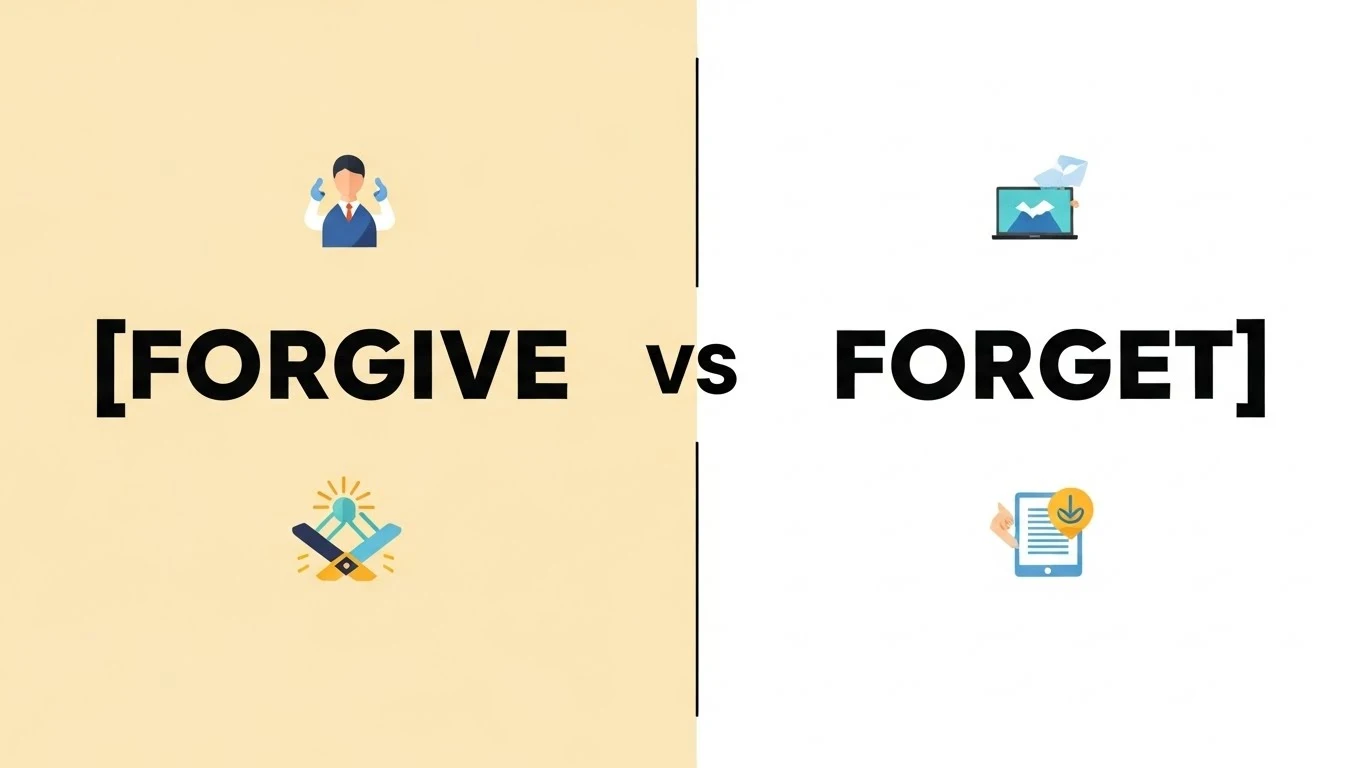
Forgive vs Forget: Side-by-Side Comparison
| Word | Meaning | Focus |
|---|---|---|
| forgive | release anger or blame | emotions |
| forget | lose memory | mind |
This distinction explains why the phrase causes confusion but remains popular.
FAQs About Forgive or Forget
1. Do I have to forget in order to forgive?
No. Forgetting is not required.
2. Is “forgive and forget” realistic?
Often no. Memory usually remains.
3. Is forgiving the same as excusing behavior?
No. You can forgive without approval.
4. Can you forget without forgiving?
Yes, but emotional resentment may stay.
5. Is the phrase religious?
It has religious roots but is now widely used.
6. Is it okay not to forgive?
That is a personal choice.
7. Is the phrase used in formal writing?
Yes, but usually with explanation.
Conclusion
The phrase forgive or forget sounds simple, but its meaning is deep and layered. Forgiving means releasing anger and resentment. Forgetting means losing memory. These are not the same thing, and English treats them differently for a reason.
You can forgive someone while still remembering what happened. In fact, many experts argue that remembering helps protect you from future harm. There is no spelling difference across English varieties, but meaning and usage matter greatly.
In writing, clarity is essential. In life, forgiveness is about peace—not memory loss. When used thoughtfully, forgive or forget becomes helpful advice rather than emotional pressure. Choosing the right words leads to clearer thinking, better communication, and wiser understanding.
I am Robert Tressell, the pen name of Robert Noonan, a British–Irish novelist and political writer. I am best known for my novel The Ragged-Trousered Philanthropists, which presents a strong depiction of working-class life and social inequality. My work remains influential in English literature and social thought.