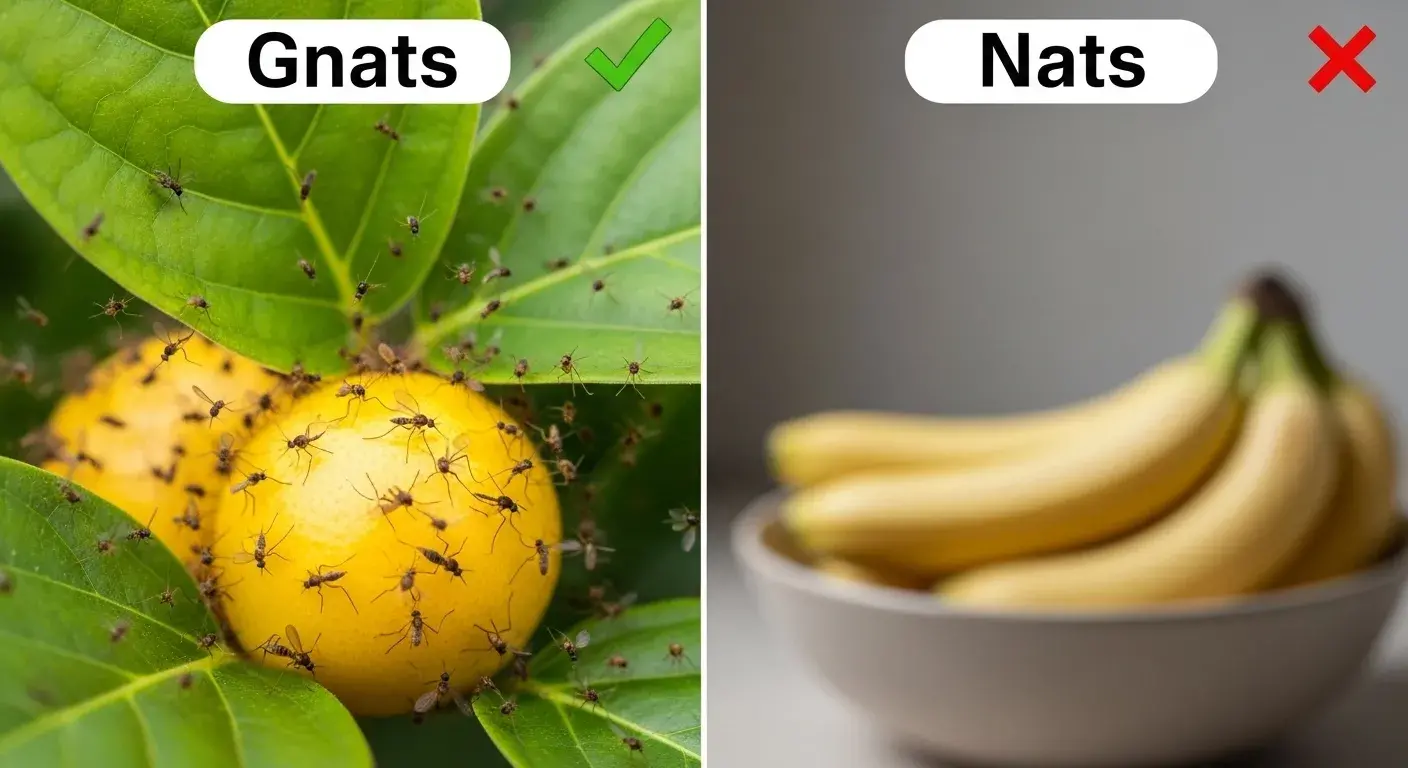
Short answer: Gnats is the correct word for tiny flying insects. Nats is not a correct spelling for the insect and is only used as a name, abbreviation, or informal term in other contexts.
Many people search for “gnats or nats” because the words sound the same when spoken aloud.
The “g” in gnats is silent, which makes the spelling confusing, especially for learners of English and non-native speakers. When you hear the word, it sounds like nats, so it feels natural to spell it that way.
This confusion often appears when people write about insects, gardening, farming, hygiene, or even daily life situations like flies in the kitchen.
Writers pause and wonder: Is it gnats or nats? Did English drop the “g” like in some other words?
This article solves that problem clearly and quickly. First, it gives a direct answer. Then, it explains where the word comes from, why the confusion exists, and how spelling rules apply in British and American English. You will also see real-life examples, common mistakes, and usage trends.
By the end, you will know exactly which spelling to use, when the other form appears, and how to avoid errors in professional writing.
Gnats or Nats – Quick Answer
Gnats ✅ is the correct spelling when referring to small flying insects.
Nats ❌ is incorrect for insects.
Examples:
- The kitchen was full of gnats.
- Gnats often appear near fruit and plants.
- ❌ There are nats in the garden. (incorrect)
The Origin of Gnats or Nats
The word gnat comes from Old English “gnætt”, which referred to a small biting insect. Over time, English pronunciation changed, but the spelling stayed the same.
This is why the “g” is silent in gnats, similar to words like:
- gnome
- gnaw
- gnash
The spelling nats did not develop as a variant of gnats. Instead, it appears separately in other contexts, such as:
- Nats as a nickname (e.g., Washington Nationals)
- NATs as a technical abbreviation
So, the spelling difference does not come from language evolution. It comes from sound-based spelling confusion.
British English vs American English Spelling
Both British and American English follow the same rule here.
| Term | American English | British English |
| Gnats | Correct | Correct |
| Nats (for insects) | Incorrect | Incorrect |
There is no regional difference. English speakers everywhere spell the insect name as gnats.
Which Spelling Should You Use?
Choose based on meaning, not audience.
- Talking about insects → Use gnats
- Writing casually but accurately → Still use gnats
- Professional or academic writing → Always use gnats
- Using “Nats” as a name or abbreviation → Capitalize it (e.g., The Nats won the game)
Rule to remember:
👉 Silent G, but never remove it in spelling.
Common Mistakes with Gnats or Nats
Mistake 1: Spelling by sound
❌ nats
✔ gnats
Mistake 2: Thinking nats is American spelling
❌ American vs British difference
✔ Same spelling worldwide
Mistake 3: Mixing spellings in one article
❌ gnats / nats together
✔ Stay consistent with gnats
Mistake 4: Forgetting the singular form
✔ One gnat, many gnats
Gnats or Nats in Everyday Examples
Emails:
- “We have a problem with gnats near the office plants.”
News:
- “Warm weather increases the number of gnats in rural areas.”
Social Media:
- “Why do gnats always fly into your face?”
Formal Writing:
- “Gnats can transmit bacteria in unsanitary environments.”
Gnats or Nats – Google Trends & Usage Data
Search data shows that “gnats” is the dominant and correct term worldwide. However, “nats” appears frequently in searches due to spelling uncertainty.
By context:
- Gardening and pest control → Gnats
- Language and spelling queries → Gnats or nats
- Sports or names → Nats (capitalized)
By region:
- USA: High searches for both, but gnats dominates
- UK: Gnats strongly preferred
- Global: Gnats used in all insect-related content
Keyword Comparison Table
| Feature | Gnats | Nats |
| Refers to insects | Yes | No |
| Correct spelling | Yes | No |
| Silent letter | G | None |
| Used in dictionaries | Yes | No (for insects) |
| content relevance | High | Confusion-based |
FAQs
1. Are gnats and nats the same thing?
No. Gnats are insects. Nats is not correct for insects.
2. Why is the “g” silent in gnats?
It comes from Old English pronunciation rules.
3. Is nats ever correct?
Yes, as a proper noun or abbreviation, not for insects.
4. Is gnats singular or plural?
Gnat is singular. Gnats is plural.
5. Do British people spell it differently?
No. Both British and American English use gnats.
6. Why do people spell it nats?
Because they spell the word the way it sounds.
7. Is gnats used in formal writing?
Yes. It is the correct and professional form.
8.why is llama spelled with two l’s? Because the word comes from Spanish, where “ll” is a special letter combination, not just a doubled L.
Conclusion
The difference between gnats or nats is simple once you understand the rule. Gnats is the correct spelling for small flying insects in all forms of English. The silent “g” may feel confusing, but it is an essential part of the word and should never be removed.
The spelling nats appears only because people write the word the way it sounds. While this is common in casual mistakes, it is not accepted in dictionaries or professional writing. There is also no British or American spelling difference here. Both follow the same standard.
For clear communication, accuracy matters. Whether you are writing a blog post, an email, a school assignment, or professional content, using gnats builds credibility and avoids confusion. If you ever hesitate, remember this simple tip: if you mean insects, keep the silent “g.”
Knowing small spelling rules like this improves your writing and helps you sound confident. Now, when someone asks “gnats or nats,” you have a clear and correct answer.
Learn more:
Colander or Strainer: What’s the Difference ?(2026)

I am Robert Tressell, the pen name of Robert Noonan, a British–Irish novelist and political writer. I am best known for my novel The Ragged-Trousered Philanthropists, which presents a strong depiction of working-class life and social inequality. My work remains influential in English literature and social thought.