You searched for “hinderance or hindrance” because these two spellings look almost identical, sound the same, and frequently appear in writing. Many writers hesitate when typing this word, especially in emails, reports, essays, and formal documents.
Spellcheck tools often highlight one version without explaining the reason, which adds to the confusion.
Is hinderance an acceptable alternative? Is hindrance only used in British English? Or are both correct depending on context?
This article clears up all confusion. You will learn the correct spelling, the history behind it, real-world examples, and practical tips to ensure you never make this mistake again.
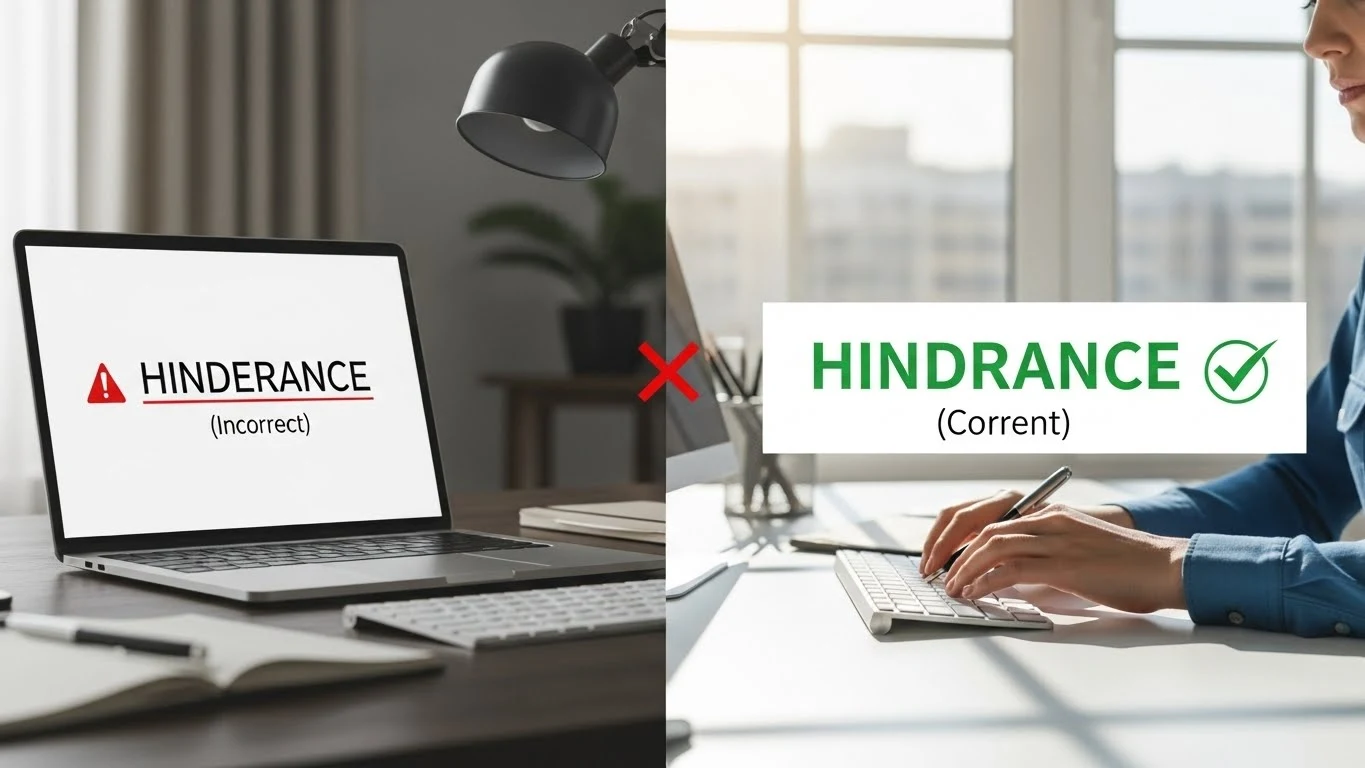
Hinderance or Hindrance – Quick Answer
Hindrance is the correct spelling.
Hinderance is incorrect and considered a spelling error.
✅ Lack of time is a major hindrance.
❌ Lack of time is a major hinderance.
The correct noun form drops the “-er” and uses -rance, not -erance.
What Does Hindrance Mean?
Hindrance is a noun that means something that slows down, blocks, or makes progress difficult.
Common meanings include:
- An obstacle
- A delay
- A restriction
- A barrier to success
Examples:
- Poor communication can be a hindrance to teamwork.
- Weather conditions became a serious hindrance to travel.
- Fear is often a hindrance to personal growth.
The Origin of Hinderance or Hindrance
The word hindrance comes from the verb hinder, which means to obstruct or delay.
In Middle English, many nouns formed from verbs ended in -rance or -ance.
Examples:
- Enter → entrance
- Perform → performance
- Endure → endurance
However, not every verb keeps its full form when becoming a noun. In this case, English settled on hindrance, not hinderance. The extra -er was never part of the standard noun.
Over time, people began spelling it incorrectly because:
- The verb hinder is very common
- Writers assume the noun must be hinder + ance
Historically and grammatically, that assumption is wrong.
Why “Hinderance” Looks Correct (But Isn’t)
The spelling hinderance feels logical, which is why the mistake is so common.
Reasons people get confused:
- The base verb is hinder
- Many English nouns add -ance to verbs
- The pronunciation does not clearly reveal the missing “er”
However, English spelling often follows historical usage rather than logic. Despite how it looks, hinderance has never been accepted in standard English.
British English vs American English Spelling
There is no difference between British and American English in this case.
| English Type | Correct Spelling | Example |
| British English | Hindrance | Noise is a hindrance. |
| American English | Hindrance | Cost is a hindrance. |
Unlike words such as colour/color or defence/defense, hindrance remains the same worldwide.
Which Spelling Should You Use?
Always use hindrance, regardless of your audience.
- US audience → Hindrance
- UK audience → Hindrance
- Academic writing → Hindrance
- Business writing → Hindrance
- Online content → Hindrance
There is no correct situation where hinderance should be used.
Common Mistakes with Hinderance or Hindrance
❌ Writing hinderance because of the verb hinder
✔ Remember: the noun drops -er
❌ Thinking both spellings are acceptable
✔ Only hindrance is correct
❌ Ignoring spellcheck warnings
✔ Fix the spelling before publishing
❌ Assuming spelling changes by region
✔ It does not
Hinderance or Hindrance in Everyday Examples
Emails
- Technical issues are a hindrance to our progress.
News
- Budget cuts became a hindrance to the project’s completion.
Social Media
- Self-doubt can be a hindrance to success.
Formal Writing
- Regulatory barriers remain a hindrance to economic reform.
Comparison Table: Hinderance vs Hindrance
| Word | Correct | Notes |
| Hindrance | ✅ Yes | Standard English noun |
| Hinderance | ❌ No | Common spelling mistake |
Hinderance or Hindrance – Google Trends & Usage Insight
Search data shows that many users type “hinderance or hindrance” to confirm the correct spelling. This is especially common among:
- Students
- Office professionals
- Bloggers and writers
- Editors and proofreaders
The high search volume proves that the confusion is widespread. However, dictionaries, style guides, and grammar references all agree on one point: hindrance is the only accepted spelling.
FAQs About Hinderance or Hindrance
1. Is hinderance ever correct?
No. It is always incorrect.
2. Why do people spell it wrong so often?
Because it comes from the verb hinder, which misleads writers.
3. Is hindrance used in British English?
Yes.
4. Is hindrance used in American English?
Yes.
5. Is hindrance a noun or a verb?
It is a noun.
6. What is the verb form?
Hinder.
7. Can spellcheck detect this error?
Yes, in most modern tools.
Learn more : Sales or Sells: Which One Is Correct and When to Use It
Conclusion
The confusion between hinderance or hindrance is common, but the rule is simple. Hindrance is the correct spelling, and hinderance is always wrong. The mistake happens because the verb hinder makes writers assume the noun keeps the same structure. It does not.
This spelling rule is consistent across British and American English, formal and informal writing. If you remember that the noun drops the “-er”, you will never hesitate again.
Correct spelling builds clarity, trust, and professionalism. With this guide, you now have the rule, the reason, and the confidence to use hindrance correctly every time.

I am Samuel Reedman, a digital English content creator who writes educational comparison posts for learners worldwide. My work emphasizes correct word usage, pronunciation differences, and practical examples for daily communication.