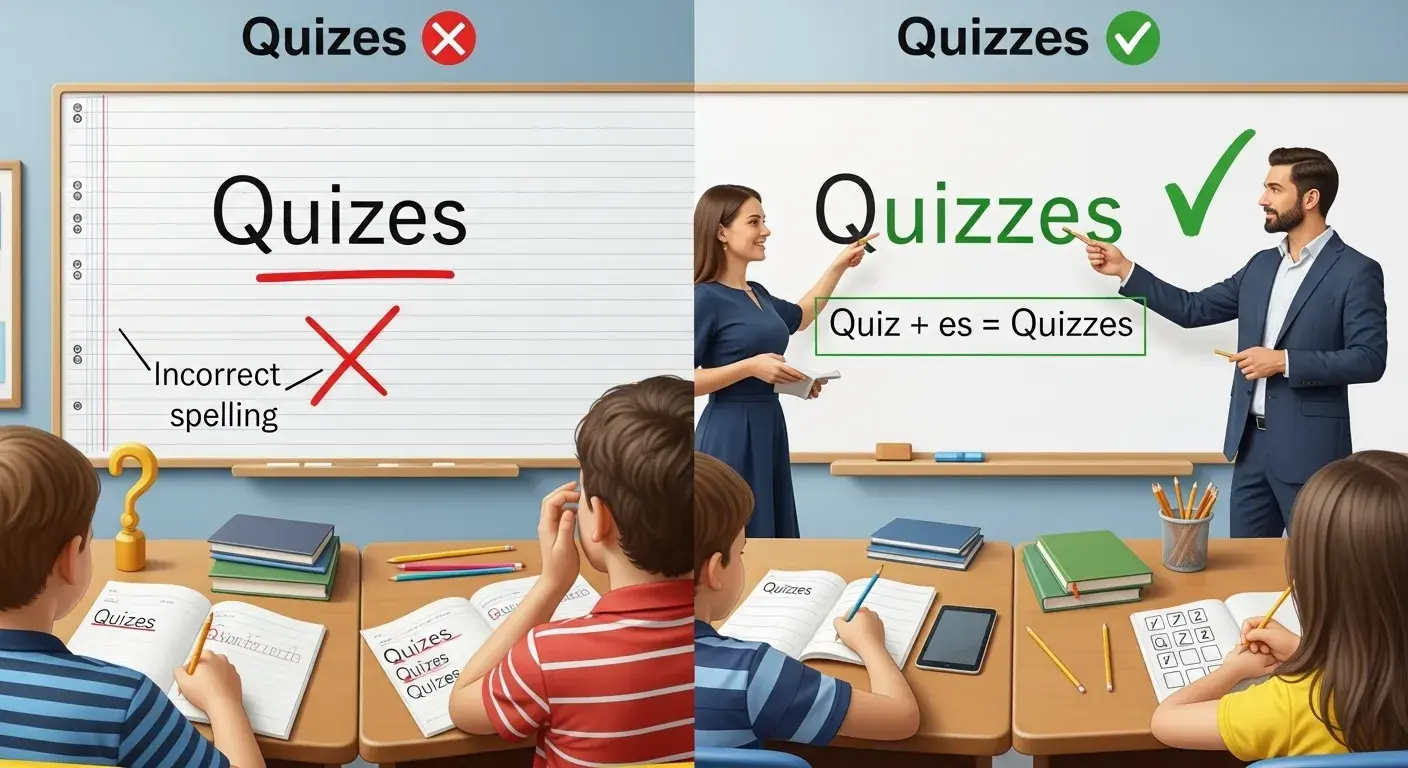
The words quizes or quizzes confuse many English learners and writers. At first glance, both spellings seem possible. Many English words simply add “-es” to form the plural.
Because of this rule, some people think quizes should be correct. However, English spelling rules can be tricky.
People often search for quizes or quizzes when writing school assignments, blog posts, online courses, or educational content.
They want to make sure their spelling is correct before publishing or submitting their work. Spellcheck tools sometimes catch the error, but not everyone notices it immediately.
This confusion happens because the base word quiz ends with the letter z, and English spelling rules sometimes double that letter when adding endings.
Writers who are unsure about the rule may type quizes, which looks logical but is actually incorrect.
Understanding the correct spelling matters because quiz is a common word in education, online learning, and digital content. A small spelling mistake can make writing look careless or unprofessional.
Quizes or Quizzes – Quick Answer
The correct plural spelling is quizzes.
The spelling quizes is incorrect.
English doubles the “z” before adding “-es.”
Examples:
- Correct: We had two quizzes in class today.
- Correct: The teacher graded the quizzes yesterday.
- Incorrect: We had two quizes today.
So remember this simple rule:
quiz → quizzes
The Origin of Quizes or Quizzes
The word quiz appeared in English in the late 1700s. At first, it meant a puzzle, question game, or test of knowledge.
Some historians believe the word came from informal slang, while others say it may have developed from older dialect words related to questioning or teasing.
Over time, quiz became a standard word in education. Schools, newspapers, and later online platforms began using it to describe short tests or knowledge games.
When forming the plural, English spelling rules apply. Words that end in “z” often double the letter before adding “-es.” This is why the correct plural form became quizzes.
The spelling quizes ignores this doubling rule, which is why dictionaries and grammar guides consider it incorrect.
British English vs American English Spelling
Unlike many English words, quiz has the same spelling in both British and American English. There is no regional difference.
Both forms follow the same plural rule.
| Form | British English | American English |
| Singular | quiz ✅ | quiz ✅ |
| Plural | quizzes ✅ | quizzes ✅ |
| Incorrect | quizes ❌ | quizes ❌ |
No matter where you are writing—UK, US, or anywhere else—quizzes is the only correct plural form.
Which Spelling Should You Use?
You should always use quizzes when writing for any audience.
Use quizzes for:
- US readers
- UK readers
- Global audiences
- Academic writing
- Blogs and online content
- Educational platforms
There is no situation where “quizes” is correct.
If you remember one rule, remember this:
The plural of quiz is always quizzes.
Common Mistakes with Quizes or Quizzes
Many writers make small spelling mistakes with this word.
Here are some common errors and corrections:
❌ We completed three quizes today.
✅ We completed three quizzes today.
❌ The teacher checked all the quizes.
✅ The teacher checked all the quizzes.
❌ Online quizes help students learn.
✅ Online quizzes help students learn.
These mistakes usually happen because writers forget to double the “z.”
Quizes or Quizzes in Everyday Examples
The word quizzes appears in many everyday situations.
Please complete the weekly quizzes before Friday.
News
Online learning platforms now use short quizzes to test knowledge.
Social Media
I finished all the course quizzes today!
Formal Writing
Students completed several quizzes during the semester.
Education Platforms
Interactive quizzes help learners remember key concepts.
Quizes or Quizzes – Google Trends & Usage Data
Search data shows that quizzes is used far more often than quizes.
Many people search quizes because they are unsure about the correct spelling. Search engines and grammar tools often guide users toward the correct form.
Online education platforms, schools, and professional publications consistently use quizzes.
The incorrect spelling quizes usually appears in:
- Typing mistakes
- Informal posts
- Early drafts of writing
Trusted sources almost always use quizzes.
Comparison Table: Quizes vs Quizzes
| Word | Correct? | Meaning | Usage |
| quiz | ✅ Yes | A short test or question game | Singular noun |
| quizzes | ✅ Yes | More than one quiz | Plural noun |
| quizes | ❌ No | Spelling mistake | Should not be used |
FAQs
1. Is “quizes” ever correct?
No. Quizes is always incorrect. The correct plural is quizzes.
2. Why does quizzes have two “z” letters?
English doubles the z before adding “-es.” This keeps the pronunciation correct.
3. What is the plural of quiz?
The plural form is quizzes.
4. Do British and American English spell it differently?
No. Both use quiz and quizzes.
5. Why do people write quizes?
Many people forget the double “z” rule when forming the plural.
6. Is quiz a countable noun?
Yes. You can say one quiz, two quizzes, three quizzes, and so on.
7. Are quizzes used only in schools?
No. Quizzes are used in education, entertainment, online learning, and social media.
Conclusion
The spelling quizzes is the only correct plural form of quiz. The spelling quizes is a common mistake. This error happens because writers forget that English doubles the letter “z” before adding “-es.”
The word quiz is widely used in schools, online learning platforms, blogs, and training programs. Because it appears so often in educational content, spelling it correctly is important. A small mistake like quizes can make writing look careless or unprofessional.
Fortunately, the rule is simple. Just remember that quiz becomes quizzes, not quizes.
Both British and American English follow the same spelling rule. There is no regional difference. If you are writing for students, teachers, or a global audience, always use quizzes.
By remembering this simple rule and reviewing the examples in this guide, you can avoid this common spelling mistake and write with confidence every time.
Learn more related post:
Angle or Angel: Meaning and Difference Explained

I am Olga Tokarczuk, a Polish novelist and essayist whose work is widely studied for its rich vocabulary, precise language, and literary expression. My writings are often referenced in academic and linguistic contexts for their clarity of diction and thoughtful use of words. I am a prominent figure in modern world literature.