Few English questions cause more stress than racking or wracking. Writers see both forms everywhere. News sites use one. Teachers mark the other wrong. Spellcheck often stays silent. So people search this keyword to get a clear, fast answer.
The confusion comes from sound. Both words sound the same. But their meanings started out different. Over time, people mixed them. Now both appear in common phrases like nerve-racking and wracking pain. This makes writers pause, rethink, and doubt their choice.
This article solves that problem. You will get a quick answer first. Then you will learn where the words came from and why two spellings exist. You will see how British and American English treat them. You will also get real examples from daily writing. By the end, you will know which spelling to use, why it works, and how to avoid common mistakes. Simple rules. Clear advice. No stress.
learn more: Dog or Bread: Which Word Is Correct and When we use?
Racking or Wracking – Quick Answer
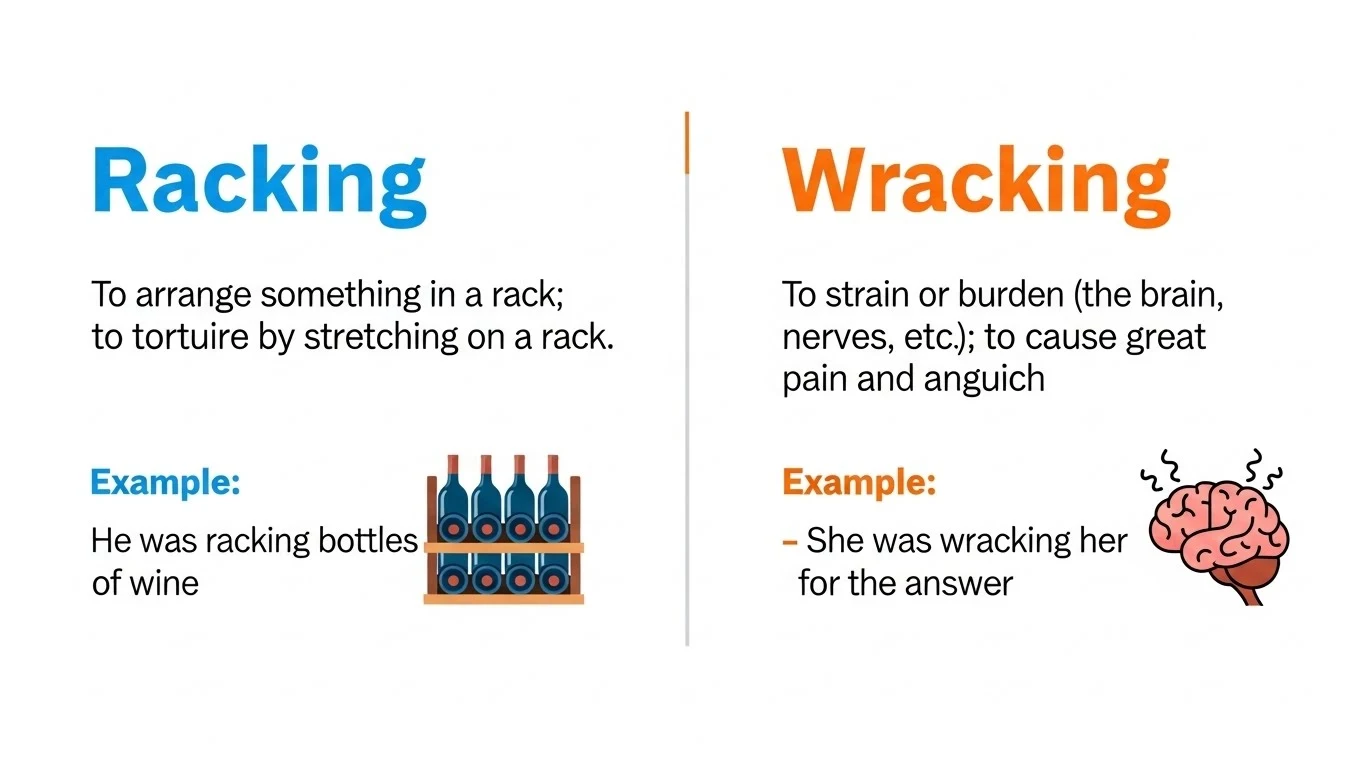
Both spellings are correct, but they are used differently.
- Racking comes from rack, meaning to strain or stretch.
- Example: The suspense was nerve-racking.
- Wracking comes from wrack, meaning to cause pain or ruin.
- Example: She felt wracking pain.
Today, racking is more common in most phrases.
The Origin of Racking or Wracking
The word rack dates back to Middle English. It meant a frame used to stretch or torture. Over time, it also meant mental strain.
Wrack came from an Old English word meaning wreck or ruin. It often described damage, pain, or destruction.
Because the meanings overlap, people began to mix them. Writers used both spellings for the same idea. Dictionaries later accepted both in some phrases. That is why confusion still exists today.
British English vs American English Spelling
This is not a strict UK vs US rule. Both forms appear in both regions. Still, usage trends differ.
| Phrase Example | American English | British English |
| nerve-racking | Very common | Common |
| wracking pain | Less common | More accepted |
| racking one’s brain | Standard | Standard |
American style guides favor racking more often.
Which Spelling Should You Use?
- US audience: Use racking in most cases.
- UK or Commonwealth: Both are fine, but racking is safer.
- Global or professional writing: Choose racking for clarity and acceptance.
When unsure, racking is the better choice.
Common Mistakes with Racking or Wracking
- ❌ wracking my brain
✅ racking my brain - ❌ nerve-wracking test
✅ nerve-racking test - ❌ Mixing both forms in one article
✅ Pick one correct form and stay consistent
Racking or Wracking in Everyday Examples
- Email: I’m racking my brain to find the file.
- News: The team faced a nerve-racking final match.
- Social media: This wait is racking my nerves.
- Formal writing: The illness caused racking pain.
Racking or Wracking – Google Trends & Usage Data
Search interest shows that racking is used more often worldwide. The phrase nerve-racking leads in the US, UK, Canada, and Australia. Wracking appears mainly with physical pain or stress. Online content, media, and schools favor racking, which keeps it dominant today.
Racking vs Wracking: Side-by-Side Comparison
| Word | Core Meaning | Common Use Case |
| racking | Strain or stress | nerve-racking, racking brain |
| wracking | Pain or destruction | wracking pain |
FAQs About Racking or Wracking
1. Is “nerve-wracking” wrong?
No, but nerve-racking is more accepted.
2. Which spelling do dictionaries prefer?
Most list racking as the main form.
3. Can I use wracking at all?
Yes, especially for physical pain.
4. What do teachers expect?
Usually racking, especially in essays.
5. Does spellcheck catch this?
Often no. Both are real words.
6. Is one more formal?
Racking sounds more neutral and safe.
7. Which is better for SEO writing?
Use racking, unless context demands pain.
Conclusion
The debate over racking or wracking feels harder than it should be. The truth is simple. Both spellings exist, but they do not carry equal weight today. Racking is the clear winner for most uses. It fits mental stress, tension, suspense, and common phrases. That is why it appears more in search results, news, and formal writing.
Wracking still has a place. It works best when you describe real pain or damage. Even then, many writers still choose racking for safety. If your audience is global, professional, or academic, stick with racking. It avoids doubt and reads clean.
Remember one rule. When in doubt, choose the form most readers expect. Clear writing builds trust. Knowing this difference helps you write faster and with confidence. No second guessing. No corrections later. Just strong, correct English.
Learn racking or wracking meaning, differences, examples, and correct usage for US and UK writing with quick answers today online.

I am Robert Tressell, the pen name of Robert Noonan, a British–Irish novelist and political writer. I am best known for my novel The Ragged-Trousered Philanthropists, which presents a strong depiction of working-class life and social inequality. My work remains influential in English literature and social thought.