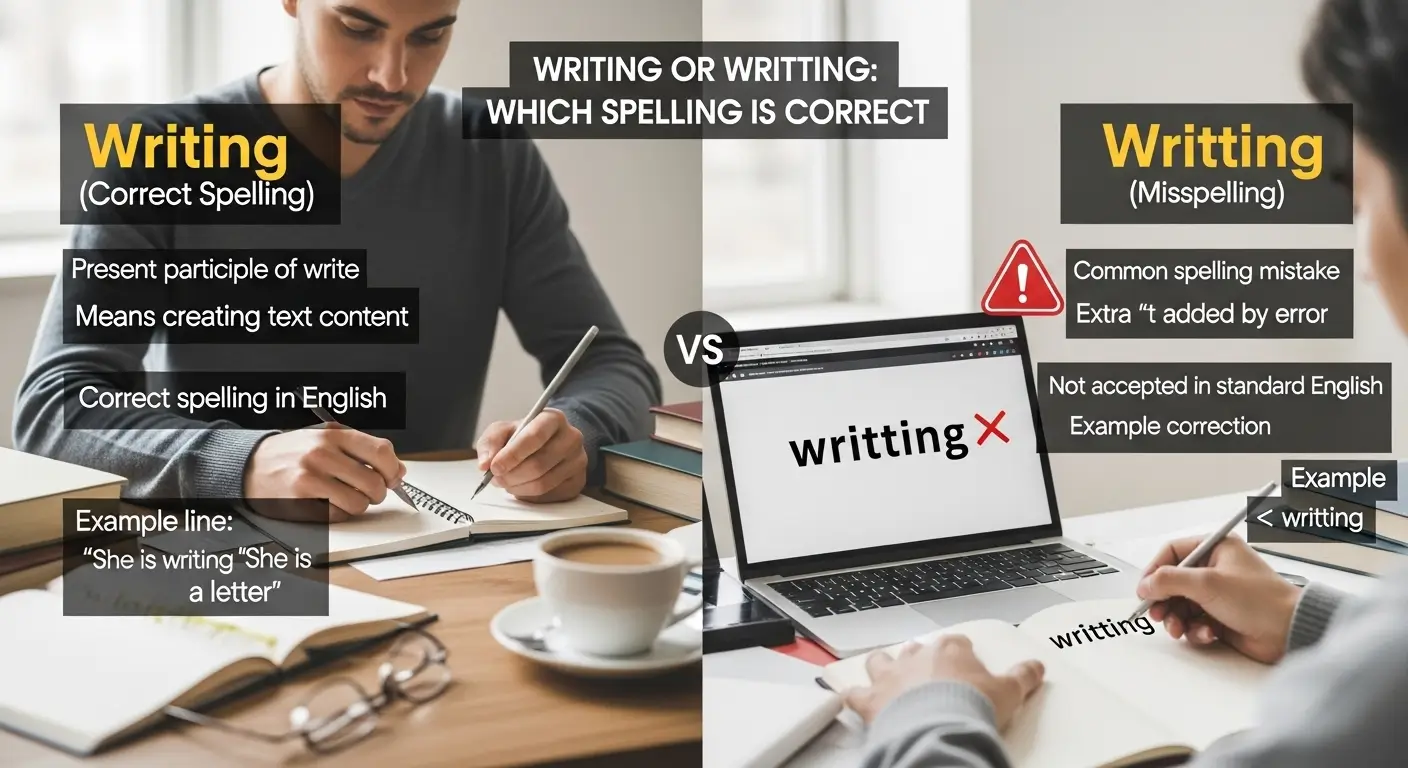
Many people search “writing or writting” because they are unsure about the correct spelling. The words sound the same when spoken, but only one spelling is correct in standard English.
This confusion often happens when learners apply common spelling rules, especially the rule about doubling consonants before adding -ing.
For example, words like running and sitting double the last letter. Because of this, some writers assume that write should become writting when adding -ing. However, English spelling rules work differently for this word.
The correct spelling is writing, which comes from the verb write. When -ing is added, the silent “e” is removed, forming writing.
The spelling writting is simply a common mistake and is not accepted in dictionaries or formal writing.
Understanding the difference between writing and writting helps students, bloggers, and professionals avoid spelling errors.
This guide explains the correct spelling, origin, usage examples, and common mistakes so you can use the word confidently.
Writing or Writting – Quick Answer
The correct spelling is writing.
- Writing → Correct spelling of the present participle of write
- Writting → Incorrect spelling
Examples
✔ Correct:
“She is writing a letter.”
❌ Incorrect:
“She is writting a letter.”
Another example:
✔ “He enjoys writing stories.”
Simple rule:
Write → Writing (drop the silent “e”)
The Origin of Writing or Writting
The word write comes from the Old English word “writan.” It originally meant to carve or mark symbols. In ancient times, people carved letters into wood, stone, or metal.
Over time, the meaning expanded to include putting words on paper.
When forming the present participle, English usually removes the silent “e” before adding -ing.
Example:
| Base Word | -ing Form |
| write | writing |
| make | making |
| move | moving |
Because of this rule, writting never developed as a correct form in English.
British English vs American English Spelling
Some English words have different spellings in British and American English. However, writing is spelled the same in both versions.
| Word | British English | American English | Status |
| Writing | Writing | Writing | Correct |
| Writting | Writting | Writting | Incorrect |
So no matter where you are writing English, writing is always the correct spelling.
Which Spelling Should You Use?
You should always use writing in all situations.
Use writing when referring to:
- Creating text
- Articles or stories
- Emails or messages
- Academic or professional work
Examples
✔ “She is writing a blog post.”
✔ “Good writing requires practice.”
✔ “He is writing an email to his manager.”
Avoid writting, because it is considered a spelling error.
Common Mistakes with Writing or Writting
Many learners make mistakes because of spelling patterns in English.
Mistake 1
❌ “I am writting a report.”
✔ Correct: “I am writing a report.”
Mistake 2
❌ “She loves writting poems.”
✔ Correct: “She loves writing poems.”
Mistake 3
Doubling the letter t incorrectly.
Remember:
Drop the silent “e”, then add -ing.
Writing or Writting in Everyday Examples
Here are examples showing how writing appears in daily communication.
“Hi John, I am writing to confirm our meeting tomorrow.”
News
“The author is writing a new novel this year.”
Social Media
“Just started writing my first blog post!”
Formal Writing
“Clear writing helps readers understand complex ideas.”
Writing or Writting – Google Trends & Usage Data
Search data shows that “writing” is extremely common worldwide. It appears in education, blogging, journalism, and communication.
People search “writting” mainly because they are unsure about spelling.
Countries where the query appears often
- United States
- United Kingdom
- India
- Canada
- Australia
Most searches come from:
- Students learning English
- Bloggers and writers
- People checking spelling before publishing content
This shows the importance of understanding the correct spelling.
Comparison Table: Writing vs Writting
| Feature | Writing | Writting |
| Correct spelling | Yes | No |
| Meaning | Act of creating text | Misspelling |
| Found in dictionaries | Yes | No |
| Used in formal writing | Yes | No |
FAQs
1. Is writting a correct spelling?
No. Writting is incorrect. The correct spelling is writing.
2. Why do people spell writing as writting?
People often apply the rule of doubling consonants, but it does not apply to this word.
3. What is the rule for writing?
Drop the silent “e” from write, then add -ing.
Write → Writing
4. Is writing spelled differently in British and American English?
No. Both use the same spelling: writing.
5. What does writing mean?
Writing means creating text using words, letters, or symbols.
6. Is writing a noun or verb?
It can be both.
- Verb: “She is writing a letter.”
- Noun: “His writing is excellent.”
7. Why is spelling important in writing?
Correct spelling helps readers understand your message clearly and makes your writing look professional.
Conclusion
The confusion between writing and writting is common, especially among English learners. Both words sound the same, but only one spelling is correct. The correct form is writing, which comes from the verb write.
When forming the -ing version of a verb that ends with a silent “e,” English usually drops the e before adding -ing. That is why write becomes writing. The spelling writting, with two “t” letters, does not follow this rule and is considered incorrect.
Fortunately, the spelling writing is the same in both British and American English. This means you can confidently use it in any type of English communication, including emails, essays, articles, and professional documents.
Remember this simple rule: write → writing. By understanding this pattern, you can avoid common spelling mistakes and improve the clarity and professionalism of your writing.
Learn more:
Quizes or Quizzes: Which Spelling Is Correct?

I am Robert Tressell, the pen name of Robert Noonan, a British–Irish novelist and political writer. I am best known for my novel The Ragged-Trousered Philanthropists, which presents a strong depiction of working-class life and social inequality. My work remains influential in English literature and social thought.