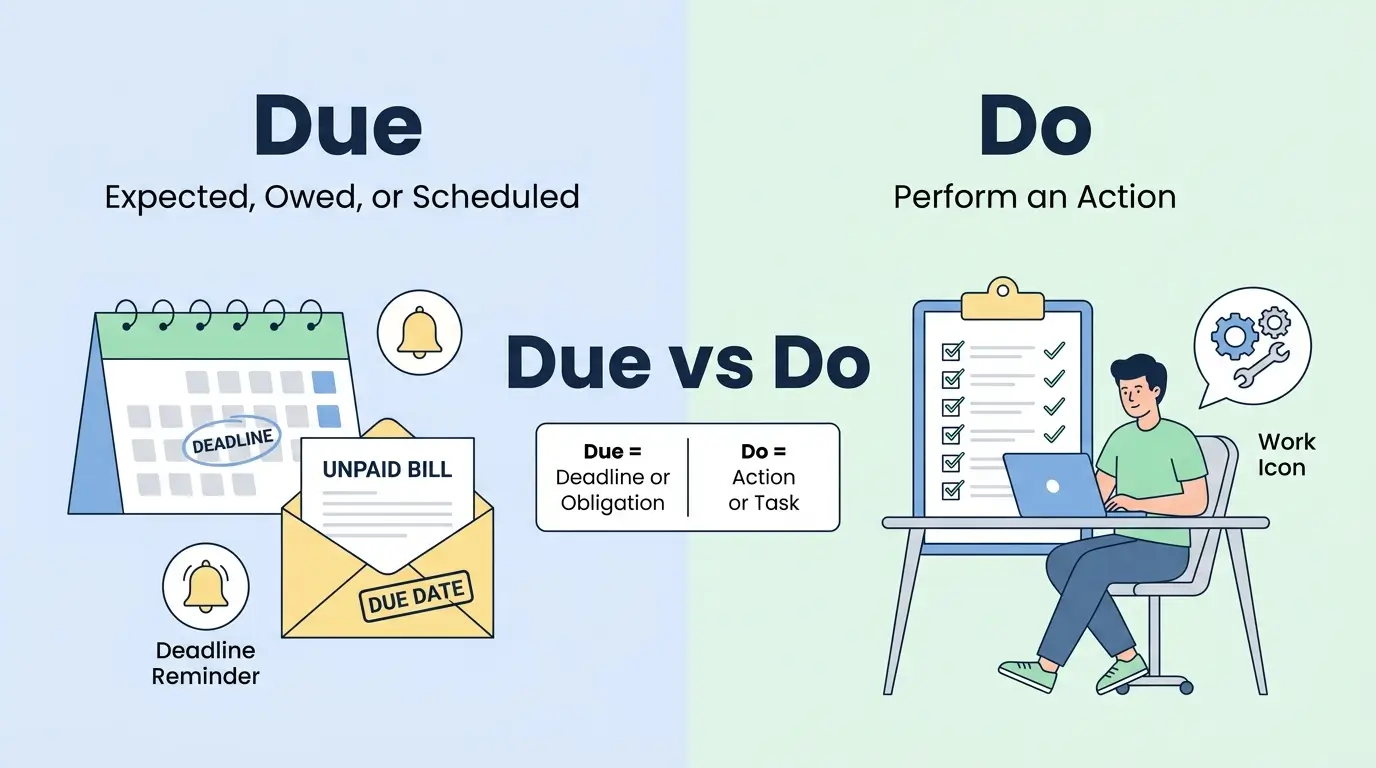
Due and do are both correct English words, but they have different meanings. Due usually means expected, owed, or scheduled, while do means to perform an action or complete a task. Use due for deadlines and obligations, and use do for actions and activities.
Have you ever paused while writing and wondered whether you should use due or do? You are not alone. These two words sound exactly the same in many English accents, making them a common source of confusion for students, writers, professionals, and English learners.
At first glance, the words seem similar because they share the same pronunciation. However, their meanings are completely different. One relates to deadlines, expectations, and obligations, while the other refers to actions, tasks, and activities. Using the wrong word can change the meaning of your sentence and make your writing look careless.
For example, saying “My homework is do tomorrow” is incorrect because the sentence requires due, not do. Likewise, “I due my homework every evening” is also wrong because the action requires do.
This guide explains the difference between due and do, their origins, common mistakes, real-world examples, and practical tips for choosing the correct word every time. By the end, you will know exactly when to use each one.
Due or Do – Quick Answer
The difference is simple:
| Word | Meaning | Example |
| Due | Expected, owed, or scheduled | The report is due Friday. |
| Do | Perform an action or task | I need to do my homework. |
Examples:
- My assignment is due tomorrow.
- I need to do my assignment tonight.
- The payment is due next week.
- What should we do now?
Simple rule:
- Due = deadline, obligation, or expectation.
- Do = action, task, or activity.
The Origin of Due or Do
Although these words sound alike today, they come from different origins.
Due
The word due comes from Old French deu, meaning “owed” or “required.” It eventually entered Middle English and became associated with obligations, debts, deadlines, and expectations.
Examples:
- Money due
- Rent due
- Assignment due
Do
The word do comes from Old English don, meaning “to perform” or “to carry out.”
For centuries, it has been one of the most common verbs in English.
Examples:
- Do work
- Do homework
- Do chores
Because the words developed from different language roots, they have always had different meanings despite sounding similar.
British English vs American English Spelling
There is no spelling difference between British and American English.
| Meaning | British English | American English |
| Deadline or obligation | Due | Due |
| Action or task | Do | Do |
Both versions of English use the same spellings and meanings.
Which Spelling Should You Use?
The answer depends entirely on what you want to say.
Use Due When:
- Talking about deadlines
- Referring to money owed
- Discussing obligations
- Mentioning scheduled events
Examples:
- The project is due Monday.
- Payment is due at the end of the month.
- The train is due to arrive soon.
Use Do When:
- Talking about actions
- Describing tasks
- Referring to activities
- Asking about actions
Examples:
- I need to do my work.
- What should we do next?
- She likes to do yoga.
Audience-Based Advice
| Audience | Recommended Usage |
| US audience | Use according to meaning |
| UK audience | Use according to meaning |
| Global audience | Use according to meaning |
The rule is universal.
Common Mistakes with Due or Do
Mistake 1: Using Do for Deadlines
❌ My essay is do tomorrow.
✔ My essay is due tomorrow.
Mistake 2: Using Due for Actions
❌ I due my homework every night.
✔ I do my homework every night.
Mistake 3: Confusing Sound with Meaning
❌ Choose based on pronunciation.
✔ Choose based on context.
Mistake 4: Using Due as a Verb
❌ I due the dishes after dinner.
✔ I do the dishes after dinner.
Due or Do in Everyday Examples
Emails
The proposal is due by Friday.
Please do the revisions before submission.
News
Tax payments are due next month.
Citizens can do more to support recycling efforts.
Social Media
My final exam is due tomorrow.
Time to do some studying.
Formal Writing
The report is due at the end of the quarter.
Employees must do annual compliance training.
Due or Do – Google Trends & Usage Data
Search interest for due or do remains strong because the words are frequently confused in writing.
Why People Search This Keyword
- Homework and school assignments
- Workplace communication
- Grammar improvement
- Professional writing
- ESL learning
Countries With High Search Interest
- United States
- United Kingdom
- Canada
- Australia
- India
Most searches occur because people hear the words spoken and are unsure which spelling fits their sentence.
Comparison Table: Due vs Do
| Feature | Due | Do |
| Correct English word | Yes | Yes |
| Refers to deadlines | Yes | No |
| Refers to obligations | Yes | No |
| Refers to actions | No | Yes |
| Refers to tasks | No | Yes |
| Common in schools | Yes | Yes |
| Functions as a verb | Rarely | Yes |
| Functions as an adjective | Yes | No |
FAQs
Is due the same as do?
No. Due relates to deadlines or obligations, while do refers to actions or tasks.
Is my homework due tomorrow correct?
Yes. Due is the correct word for a deadline.
Is I do my homework correct?
Yes. Do is the correct word for performing a task.
Why do due and do sound the same?
They are homophones in many English accents.
Can due be used for payments?
Yes. Payments, bills, and debts are often described as due.
Can do be used as a helping verb?
Yes. Examples include “Do you agree?” and “I do understand.”
Do British and American English use different spellings?
No. Both use due and do in the same way.
Conclusion
The difference between due and do is simple once you understand their meanings. Due relates to deadlines, obligations, expectations, and things that are owed. Do refers to actions, tasks, and activities. Although they sound alike, they serve completely different purposes in English.
When writing, ask yourself one question: Am I talking about a deadline or an action? If it is a deadline, payment, obligation, or scheduled event, use due. If it is a task, activity, or action, use do. This simple rule works in school assignments, business communication, emails, academic writing, and everyday conversations.
There is no spelling difference between British and American English, so the choice depends entirely on meaning. Using the correct word improves clarity and helps readers understand your message immediately. Once you remember that due means owed or expected and do means perform an action, you will rarely confuse them again.
Learn more about related article:
Continuous or Discrete: What’s the Difference?(guide 2026)

I am Samuel Reedman, a digital English content creator who writes educational comparison posts for learners worldwide. My work emphasizes correct word usage, pronunciation differences, and practical examples for daily communication.