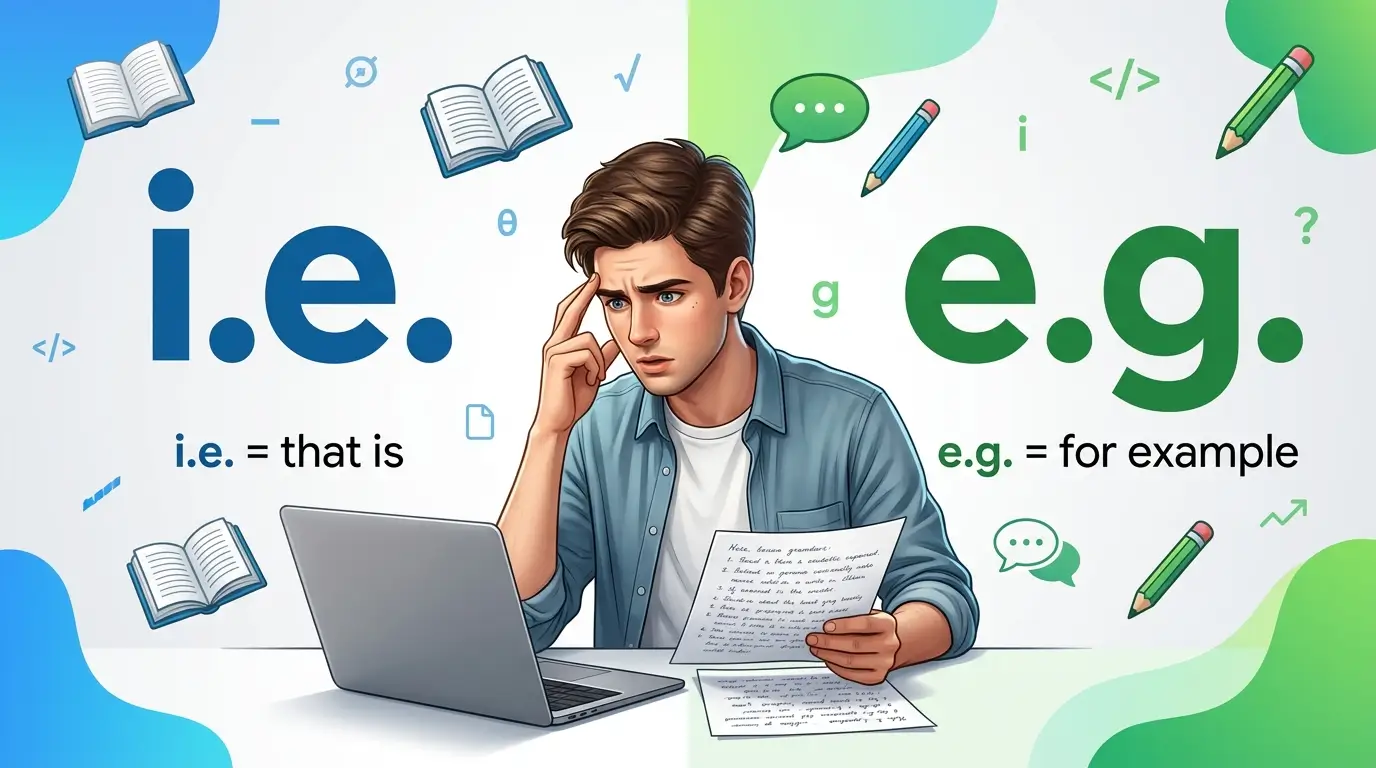
i.e. means “that is” or “in other words.” It is used to explain or clarify something.
e.g. means “for example.” It is used to give examples of something.
Many people confuse i.e. and e.g. because both are short Latin abbreviations used in writing. They often appear in emails, essays, business documents, and academic work. Since they look similar and are used inside sentences, writers sometimes use the wrong one without realizing it.
The confusion becomes even more common because both abbreviations are followed by examples or explanations. However, they do not mean the same thing. Using the wrong abbreviation can change the meaning of your sentence and make your writing unclear.
The good news is that the difference is simple once you understand the basic rule.
In this guide, you will learn:
- The exact meaning of i.e. and e.g.
- When to use each one
- Common mistakes people make
- British vs American punctuation rules
- Real-life examples
- Easy memory tricks
By the end, you will know exactly which abbreviation to use in every situation.
i.e. or e.g. – Quick Answer
| Abbreviation | Meaning | Use | Example |
| i.e. | That is | Clarification | He works remotely, i.e., from home. |
| e.g. | For example | Giving examples | Bring snacks, e.g., chips and cookies. |
Simple Rule:
- Use i.e. when you want to explain something.
- Use e.g. when you want to give examples.
The Origin of i.e. or e.g.
Both abbreviations come from Latin.
Origin of i.e.
i.e. comes from the Latin phrase id est, which means:
“that is”
or
“in other words”
It helps explain or restate information more clearly.
Example:
- She is bilingual, i.e., she speaks two languages.
Origin of e.g.
e.g. comes from the Latin phrase exempli gratia, which means:
“for example”
It is used before examples.
Example:
- Outdoor activities, e.g., hiking and cycling, are popular.
These abbreviations have been used in English writing for hundreds of years, especially in academic and professional writing.
British English vs American English Spelling
There is no spelling difference between British English and American English. Both use i.e. and e.g.
However, punctuation styles can differ slightly.
| Style | British English | American English |
| i.e. punctuation | i.e. | i.e., |
| e.g. punctuation | e.g. | e.g., |
| Meaning | Same | Same |
British Style Example
- Bring warm clothes e.g. jackets and coats.
American Style Example
- Bring warm clothes, e.g., jackets and coats.
Both styles are correct depending on your writing style guide.
Which Spelling Should You Use?
You should use both abbreviations correctly based on meaning, not region.
Use i.e. When:
- Explaining
- Clarifying
- Restating information
Example:
- The meeting is virtual, i.e., online only.
Use e.g. When:
- Giving examples
- Listing possible items
- Suggesting options
Example:
- We sell tropical fruits, e.g., mangoes and pineapples.
Audience-Based Advice
| Audience | Recommended Style |
| US audience | Use commas with i.e. and e.g. |
| UK audience | Commas optional |
| Academic writing | Follow style guide |
| Global audience | Keep punctuation consistent |
Common Mistakes with i.e. or e.g.
Many writers mix these abbreviations because they seem similar.
Mistake 1: Using i.e. for Examples
Incorrect:
- I enjoy sports, i.e., football and tennis.
Correct:
- I enjoy sports, e.g., football and tennis.
Why?
Football and tennis are examples, not a complete explanation.
Mistake 2: Using e.g. for Clarification
Incorrect:
- He is nocturnal, e.g., active at night.
Correct:
- He is nocturnal, i.e., active at night.
Why?
The second phrase explains the meaning.
Mistake 3: Forgetting Punctuation
Incorrect:
- Bring tools eg hammer screwdriver.
Correct:
- Bring tools, e.g., hammer and screwdriver.
i.e. or e.g. in Everyday Examples
Emails
- Please submit digital files, e.g., PDFs or Word documents.
- The office will remain closed, i.e., employees should work remotely.
News Writing
- Severe weather, e.g., flooding and storms, affected the region.
- The law was repealed, i.e., officially removed.
Social Media
- I love comfort food, e.g., pizza and pasta.
- She is vegan, i.e., she avoids animal products.
Formal Writing
- Certain mammals, e.g., dolphins and whales, are highly intelligent.
- The project was delayed indefinitely, i.e., no new date was given.
i.e. or e.g. – Google Trends & Usage Data
Search trends show that many people search for:
- “i.e. meaning”
- “e.g. meaning”
- “difference between i.e. and e.g.”
- “how to use i.e.”
- “how to use e.g.”
Why People Confuse Them
- Both are Latin abbreviations
- Both contain periods
- Both appear inside commas
- Both are common in formal writing
Popular Search Regions
- United States
- United Kingdom
- India
- Pakistan
- Canada
Common Usage Contexts
| Context | More Common |
| Academic writing | i.e. and e.g. |
| Business emails | e.g. |
| Technical writing | i.e. |
| Essays and reports | Both |
Comparison Table: i.e. vs e.g.
| Feature | i.e. | e.g. |
| Full Latin phrase | id est | exempli gratia |
| Meaning | that is | for example |
| Purpose | Clarification | Examples |
| Used for | Explaining | Listing |
| Example | He is nocturnal, i.e., active at night. | I like desserts, e.g., cake and ice cream. |
Easy Memory Trick
Remember This:
- i.e. = in essence
- e.g. = example given
This trick helps many writers remember the difference quickly.
FAQs
1. What does i.e. mean?
It means “that is” or “in other words.”
2. What does e.g. mean?
It means “for example.”
3. Can i.e. and e.g. be used interchangeably?
No. They have different meanings and uses.
4. Is e.g. formal or informal?
It is commonly used in both formal and informal writing.
5. Should I use commas after i.e. and e.g.?
American English usually uses commas. British English may not.
6. Which is better in academic writing?
Both are acceptable if used correctly.
7. How can I remember the difference easily?
Think:
- i.e. = explanation
- e.g. = examples
8. Is it wrong to spell out “for example” instead?
No. In casual writing, spelling it out can improve clarity.
Conclusion
The confusion between i.e. and e.g. is very common, but the difference becomes easy once you learn the basic rule. Use i.e. when you want to explain or clarify something. Use e.g. when you want to provide examples.
Although both abbreviations come from Latin, they remain widely used in modern English writing. You will see them in emails, essays, reports, textbooks, and online articles. Because they look similar, many writers accidentally swap them, but doing so can change the meaning of a sentence.
There is no major spelling difference between British and American English, though punctuation styles may vary slightly. The key is to stay consistent in your writing style.
A simple memory trick can help:
i.e. = in essence
e.g. = example given
Once you practice using them in sentences, the difference will feel natural. Correct usage improves clarity, professionalism, and reader understanding in every type of writing.
Learn more related article:
Would or Will: What’s the Difference ?(guide 2026)

I am Olga Tokarczuk, a Polish novelist and essayist whose work is widely studied for its rich vocabulary, precise language, and literary expression. My writings are often referenced in academic and linguistic contexts for their clarity of diction and thoughtful use of words. I am a prominent figure in modern world literature.