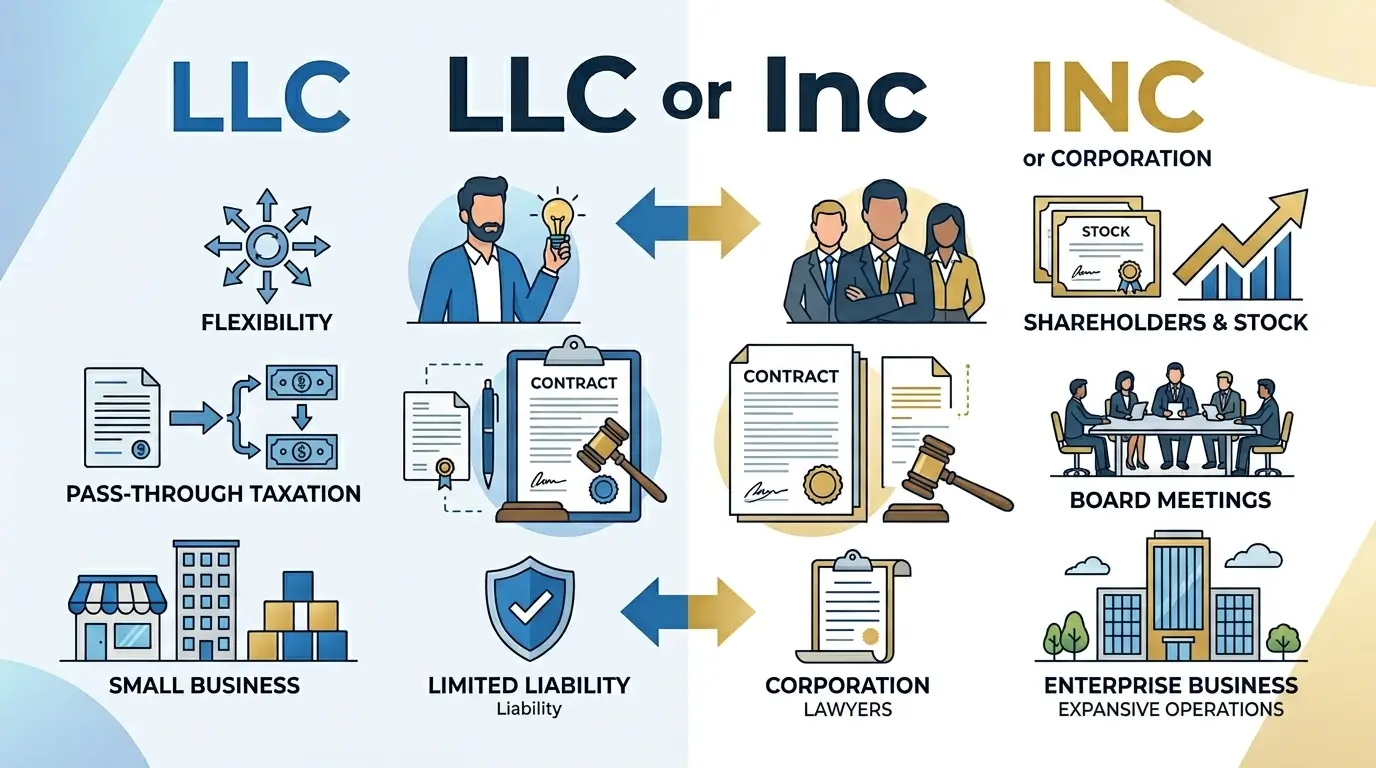
LLC and Inc are two different business structures. An LLC (Limited Liability Company) offers flexible management and pass-through taxation, while an Inc (Incorporated company or corporation) follows a more formal structure with shareholders, directors, and corporate taxes. LLCs are popular for small businesses, while corporations are often used by larger companies and startups seeking investors.
Starting a business is exciting, but choosing the right business structure can feel confusing. Many people compare LLC or Inc because both offer legal protection, but they work in very different ways. Business owners often wonder which option is better for taxes, ownership, management, and long-term growth.
The confusion happens because both terms appear after company names. You may see “LLC” on local businesses and “Inc” on large corporations. At first glance, they look similar, but the legal and financial differences are important.
Choosing the wrong structure can affect taxes, paperwork, liability protection, and even investor opportunities. That is why understanding LLC vs Inc matters for entrepreneurs, freelancers, startups, and growing companies.
This guide explains everything in simple language. You will learn the meaning, origin, advantages, disadvantages, and real-world usage of LLC and Inc. By the end, you will know which business structure fits your goals best.
LLC or Inc – Quick Answer
LLC and Inc are both legal business structures, but they operate differently.
LLC
- Stands for Limited Liability Company
- Flexible structure
- Pass-through taxation
- Easier management
- Popular for small businesses
Inc
- Stands for Incorporated (Corporation)
- Formal corporate structure
- Shareholders and directors
- Better for raising investors
- Common for large companies
Examples
LLC Example:
Bright Future Marketing LLC
Inc Example:
Global Tech Solutions Inc.
Simple Rule
Choose LLC for flexibility and simplicity.
Choose Inc if you want investors or plan to scale aggressively.
The Origin of LLC or Inc
Origin of LLC
The LLC structure started in the United States during the late 1970s. Wyoming became the first state to officially allow LLC businesses in 1977.
The idea was to combine:
- Limited liability protection from corporations
- Tax flexibility from partnerships
Over time, LLCs became popular because they offered simpler management and fewer corporate rules.
Origin of Inc
The word “Inc” comes from “Incorporated,” which means a company has legally formed a corporation.
Corporations have existed for centuries and became common during industrial expansion. Large companies needed:
- Investors
- Shareholders
- Legal separation from owners
That is why many major global companies operate as corporations.
British English vs American English Spelling
There is no spelling difference between LLC or Inc in British and American English because these are legal business abbreviations.
However, LLC is mainly a United States business structure.
Comparison Table
| Term | American English | British English |
| LLC | Common | Rare |
| Inc | Common | Less common |
| Ltd | Less common | Common UK structure |
Important Note
In the UK, businesses usually use:
- Ltd (Limited)
- PLC (Public Limited Company)
In the US, businesses usually use:
- LLC
- Inc
Which Spelling Should You Use?
Your choice depends on your business goals and country.
Use LLC If:
- You want simple management
- You run a small business
- You prefer flexible taxes
- You work as a freelancer or startup founder
Use Inc If:
- You want investors
- You plan to issue shares
- You expect large-scale growth
- You want a formal business structure
Audience-Based Advice
| Audience | Best Choice |
| Freelancers | LLC |
| Small businesses | LLC |
| Tech startups | Inc |
| Large corporations | Inc |
| Family businesses | LLC |
Common Mistakes with LLC or Inc
Many people misunderstand these business terms.
Mistake 1: Thinking LLC and Inc Mean the Same Thing
Incorrect:
“LLC and Inc are identical.”
Correct:
They are different legal structures.
Mistake 2: Using Inc Without Incorporation
Incorrect:
ABC Marketing Inc. without legal registration.
Correct:
Only use Inc after officially incorporating.
Mistake 3: Assuming LLC Pays No Taxes
Incorrect:
“LLCs are tax-free.”
Correct:
LLCs still pay taxes, but taxation works differently.
Mistake 4: Choosing Inc for Simplicity
Corporations usually require:
- Board meetings
- Corporate records
- Shareholder reporting
LLCs are usually easier to manage.
LLC or Inc in Everyday Examples
Emails
“Our company recently changed from an LLC to an Inc.”
News
“The startup incorporated as an Inc to attract investors.”
Social Media
“Thinking about opening an LLC this year.”
Formal Writing
“The corporation issued additional shares to shareholders.”
Business Contracts
“Blue Horizon Ventures LLC agrees to the following terms.”
LLC or Inc – Google Trends & Usage Data
Search interest for LLC or Inc has increased because more people are starting online businesses and startups.
LLC Searches Are Popular For:
- Small businesses
- Freelancers
- E-commerce stores
- Online entrepreneurs
Inc Searches Are Popular For:
- Corporate structures
- Investor-backed startups
- Large businesses
- Public companies
Popular Countries Searching These Terms
- United States
- Canada
- India
- Pakistan
- United Kingdom
Common Search Queries
- LLC vs Inc
- Should I choose LLC or Inc
- Difference between LLC and corporation
- Is LLC better than Inc
Comparison Table: LLC vs Inc
| Feature | LLC | Inc |
| Full Form | Limited Liability Company | Incorporated |
| Ownership | Members | Shareholders |
| Management | Flexible | Formal |
| Taxation | Pass-through | Corporate tax |
| Investor Friendly | Moderate | High |
| Paperwork | Less | More |
| Board of Directors | Not required | Required |
| Best For | Small businesses | Large companies |
| Legal Protection | Yes | Yes |
Advantages of an LLC
Flexible Taxation
Profits can pass directly to owners without corporate taxes.
Simple Management
Less paperwork and fewer legal requirements.
Liability Protection
Owners usually are not personally responsible for company debts.
Suitable for Small Businesses
Great for:
- Freelancers
- Agencies
- Online stores
- Consultants
Advantages of an Inc
Easier to Raise Money
Corporations can sell shares to investors.
Stronger Growth Potential
Large companies often choose Inc structures.
Better Business Credibility
Some investors prefer corporations.
Easier Ownership Transfer
Shares can be transferred more easily.
Disadvantages of LLC
- Harder to attract investors
- Some states charge higher LLC fees
- Limited stock options
Disadvantages of Inc
- More paperwork
- Double taxation possible
- Strict legal requirements
- More administrative costs
Real-Life Examples
Famous LLC Examples
- Small local businesses
- Marketing agencies
- Real estate firms
Famous Inc Examples
- Apple Inc.
- Microsoft Corporation
- Intel Corporation
Large public companies usually operate as corporations instead of LLCs.
LLC vs Inc for Startups
Many startups begin as LLCs because they are simple and affordable.
Later, they may convert into corporations when:
- Seeking investors
- Raising venture capital
- Expanding internationally
This is common in the tech industry.
Tax Differences Between LLC and Inc
LLC Taxes
Profits usually pass directly to owners.
This avoids double taxation.
Inc Taxes
Corporations may pay:
- Corporate taxes
- Shareholder taxes on dividends
This is called double taxation.
However, some corporations elect S-Corp status for tax benefits.
LLC or Inc for Online Businesses
LLC Is Better For:
- Bloggers
- Freelancers
- YouTubers
- Digital agencies
- Dropshipping stores
Inc Is Better For:
- Large startups
- Venture-backed companies
- Businesses planning IPOs
FAQs
1. What does LLC stand for?
LLC stands for Limited Liability Company.
2. What does Inc mean?
Inc means Incorporated, which refers to a corporation.
3. Is LLC better than Inc?
It depends on your business goals. LLC is simpler, while Inc is better for raising investors.
4. Can an LLC become an Inc?
Yes. Many businesses convert later as they grow.
5. Does LLC protect personal assets?
Yes. LLCs usually protect owners from personal liability.
6. Is Inc more expensive than LLC?
Usually yes, because corporations have more legal and administrative requirements.
7. Which structure is best for startups?
Many startups begin as LLCs but later switch to Inc structures for investment opportunities.
8. Can one person own an LLC?
Yes. Single-member LLCs are common.
Conclusion
The difference between LLC or Inc is more important than many new business owners realize. While both structures provide legal protection, they serve different purposes and business goals.
An LLC is usually the best choice for small businesses, freelancers, consultants, and online entrepreneurs who want flexibility and simple management. It offers liability protection with fewer formal requirements.
An Inc, on the other hand, works better for companies planning rapid growth, outside investment, or public expansion. Corporations provide stronger opportunities for raising capital, but they also come with more paperwork and legal rules.
There is no single “best” option for everyone. The right choice depends on your business size, tax goals, growth plans, and management preferences.
Understanding these differences helps you make smarter business decisions and avoid costly mistakes later. Once you know how LLC and Inc work, choosing the right structure becomes much easier.
Learn more :
i.e. or e.g.: What’s the Difference ? (guide 2026)