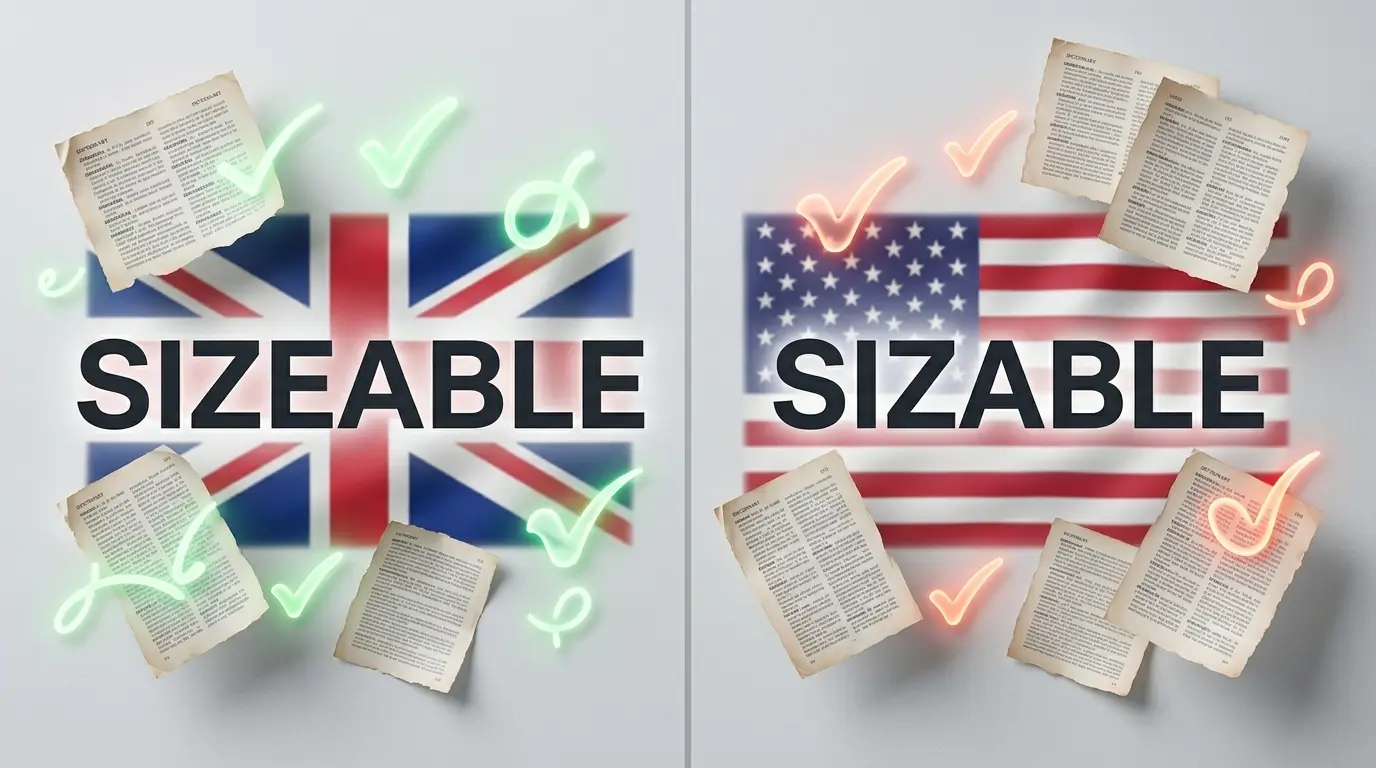
“Sizeable” and “sizable” are both correct spellings. “Sizable” is more common in American English, while “sizeable” is often used in British English. Both words mean large in size, amount, or importance. For example, “They made a sizable profit” and “They made a sizeable profit” are both correct.
English spelling can sometimes feel confusing, especially when two words look almost the same. One common example is “sizeable or sizable.” Many people wonder which spelling is correct because both versions appear online, in books, and in professional writing.
The confusion happens because British English and American English often use different spelling styles. Some words keep extra letters in British English, while American English uses shorter forms. This creates uncertainty for students, writers, bloggers, and business professionals.
If you have ever paused while typing “sizeable” or “sizable,” you are not alone. Many users search this keyword to avoid spelling mistakes and improve their writing accuracy.
The good news is simple: both spellings are correct. The real difference depends on your audience and writing style. In this guide, you will learn the meaning, origin, spelling differences, usage rules, examples, common mistakes, and expert advice on when to use each version confidently.
Sizeable or Sizable – Quick Answer
Both “sizeable” and “sizable” are correct spellings.
- “Sizable” is preferred in American English.
- “Sizeable” is more common in British English.
Meaning:
Both words mean large, important, or considerable in size or amount.
Examples:
- The company made a sizable investment.
- They received a sizeable donation.
Quick Comparison Table
| Word | Correct? | English Type | Meaning |
| Sizable | Yes | American English | Large or considerable |
| Sizeable | Yes | British English | Large or considerable |
The Origin of Sizeable or Sizable
The word comes from the noun “size,” which refers to dimensions, amount, or magnitude.
Over time, English speakers created adjectives from “size” using different spelling styles. American English preferred the shorter form “sizable,” while British English accepted “sizeable” with the added “e.”
This spelling pattern appears in many English words:
| American English | British English |
| lovable | loveable |
| usable | useable |
| sizable | sizeable |
The spelling difference developed because British English often keeps traditional forms, while American English prefers simplified spelling.
Even though the spellings differ slightly, the meaning remains exactly the same.
British English vs American English Spelling
This is mainly a regional spelling difference.
American English
Americans usually write “sizable.”
Example:
- The project required a sizable budget.
British English
British writers often prefer “sizeable.”
Example:
- The company reported a sizeable increase in sales.
Comparison Table
| Usage Area | Preferred Spelling | Example |
| United States | Sizable | A sizable crowd attended. |
| United Kingdom | Sizeable | A sizeable crowd attended. |
| Canada | Both used | Depends on style guide |
| Australia | Sizeable more common | A sizeable improvement |
| International writing | Sizable often preferred | Clear global usage |
There is no grammar difference between the two words.
Which Spelling Should You Use?
The best spelling depends on your audience.
Use “Sizable” If:
- You write for American readers
- You create international business content
- You follow AP Style
- You prefer simplified spelling
Use “Sizeable” If:
- You write for British audiences
- You follow UK spelling conventions
- Your publication uses British English
Audience-Based Advice
| Audience | Best Choice |
| US readers | Sizable |
| UK readers | Sizeable |
| Global audience | Sizable |
| Academic UK writing | Sizeable |
| SEO international content | Sizable |
If consistency matters, choose one spelling and use it throughout the article.
Common Mistakes with Sizeable or Sizable
People often make mistakes because both spellings look correct.
Common Errors
| Incorrect Usage | Correct Version |
| Mixing both spellings in one article | Use one consistently |
| Thinking one is wrong | Both are correct |
| Using British spelling for US clients | Use sizable |
| Assuming meaning changes | Meaning stays the same |
Incorrect:
- The company made a sizeable profit in its sizable market.
Better:
- The company made a sizable profit in its sizable market.
Or:
- The company made a sizeable profit in its sizeable market.
Consistency improves professionalism.
Sizeable or Sizable in Everyday Examples
Emails
- We expect a sizable increase in revenue next quarter.
- The client requested a sizeable discount.
News Writing
- The storm caused sizable damage across the region.
- The charity received a sizeable donation.
Social Media
- That was a sizable achievement.
- She built a sizeable audience online.
Formal Writing
- Researchers observed a sizable improvement in results.
- The report identified a sizeable economic impact.
Business Writing
- The company secured a sizable investment.
- The startup attracted sizeable funding.
Both spellings work naturally in professional and casual communication.
Sizeable or Sizable – Google Trends & Usage Data
Search data shows that people frequently search for “sizeable or sizable” because both spellings appear online.
Why People Search This Keyword
- Spelling confusion
- British vs American English differences
- Professional writing concerns
- SEO content writing
- Academic proofreading
Popular Search Regions
| Country | Common Spelling |
| United States | Sizable |
| United Kingdom | Sizeable |
| Canada | Both |
| Australia | Sizeable |
| India | Both |
| Pakistan | Both |
Usage Contexts
- Academic writing
- News articles
- Blogging
- SEO writing
- Business communication
Google search patterns show “sizable” has slightly higher global search volume because American English dominates online content.
Comparison Table: Sizeable vs Sizable
| Feature | Sizeable | Sizable |
| Correct spelling | Yes | Yes |
| British English | Common | Less common |
| American English | Rare | Common |
| Meaning | Large or important | Large or important |
| Formal writing | Accepted | Accepted |
| SEO global content | Good | Better reach |
| Dictionary accepted | Yes | Yes |
FAQs
1. Is “sizeable” correct?
Yes. “Sizeable” is a correct British English spelling.
2. Is “sizable” correct?
Yes. “Sizable” is the preferred American English spelling.
3. Which spelling is more common?
“Sizable” is more common globally because American English dominates digital content.
4. Do “sizeable” and “sizable” mean the same thing?
Yes. Both words mean large, considerable, or important in size or amount.
5. Should I use “sizeable” in American writing?
It is better to use “sizable” for American audiences.
6. Is “sizeable” old-fashioned?
No. It is still widely used in British English.
7. Which spelling is better for SEO?
“Sizable” usually performs better internationally because it has higher search volume.
8. Can I use both spellings in one article?
It is better to stay consistent with one spelling style.
Conclusion
The confusion between “sizeable or sizable” is very common, but the answer is simple. Both spellings are correct and accepted in standard English. The real difference comes from regional spelling preferences.
American English usually prefers “sizable,” while British English often uses “sizeable.” Neither spelling changes the meaning. Both describe something large, important, or considerable.
If your audience is international or American, “sizable” is often the safer choice because it is more widely recognized online. If you write for British readers, “sizeable” fits naturally with UK spelling conventions.
The most important rule is consistency. Once you choose one spelling, use it throughout your writing. This improves clarity, professionalism, and readability.
Understanding small spelling differences like this can make your writing stronger and more polished. It also helps avoid confusion in academic, business, and online communication.
Learn more related articles:
Caliber vs Calibre: What’s the Difference?

I am Robert Tressell, the pen name of Robert Noonan, a British–Irish novelist and political writer. I am best known for my novel The Ragged-Trousered Philanthropists, which presents a strong depiction of working-class life and social inequality. My work remains influential in English literature and social thought.