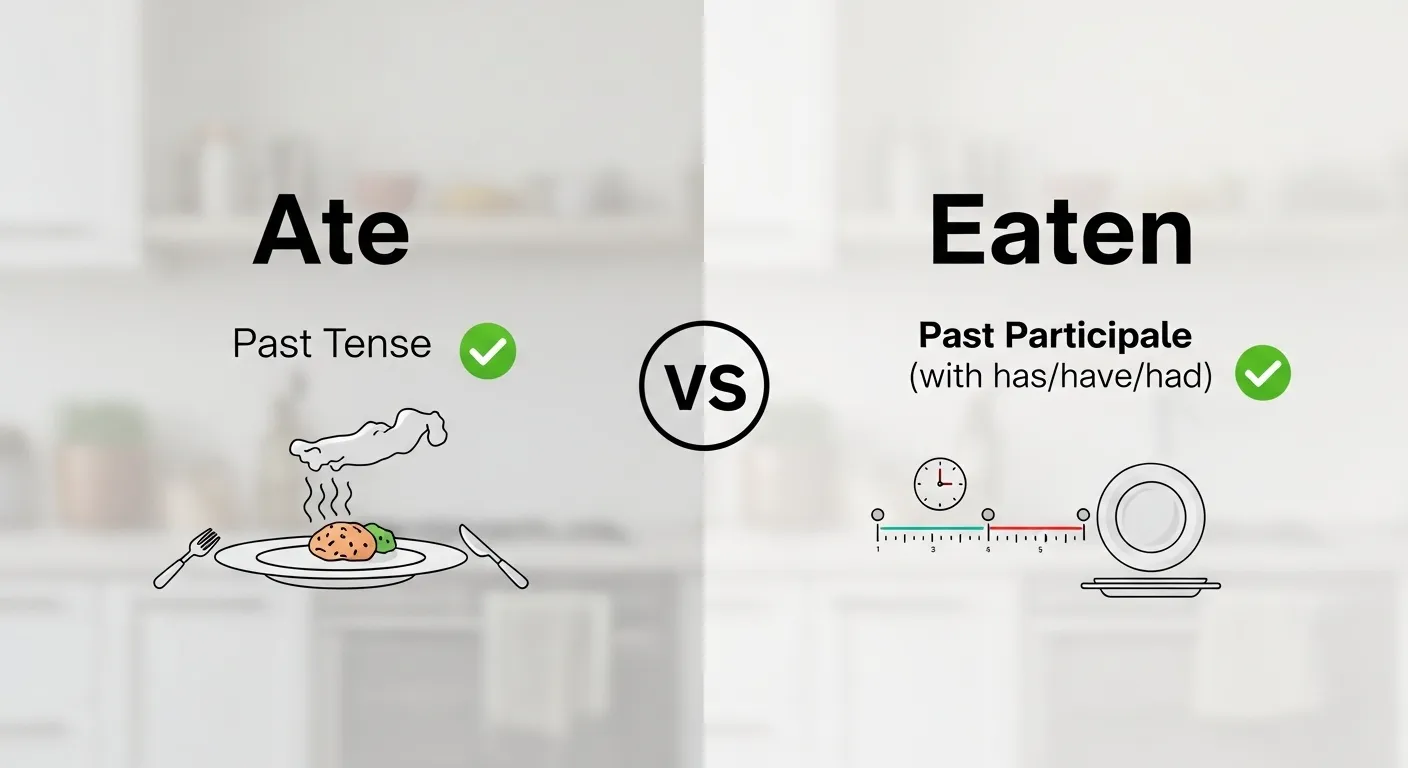
“Ate” is the simple past form of eat, while “eaten” is the past participle. Use “ate” alone for past actions, and use “eaten” with helping verbs like “has,” “have,” or “had.”
Many learners feel confused between “ate” and “eaten.” Both words come from the verb “eat,” but they are used in different ways. This confusion often appears in daily speech, writing, and exams.
The problem happens because both words talk about the past. However, English grammar has different forms for verbs. “Ate” works on its own, but “eaten” needs a helping verb.
Using the wrong form can make your sentence sound incorrect. This is important in school, professional writing, and even casual communication.
In this article, you will learn the meaning, origin, and correct use of ate and eaten. You will also see examples, common mistakes, and simple rules. By the end, you will use both words with confidence.
Ate or Eaten – Quick Answer
- Ate → Simple past tense
- Eaten → Past participle
Meaning:
Both come from the verb “eat,” which means to consume food.
Examples:
- I ate dinner at 8 PM.
- I have eaten dinner already.
Rule:
Use ate alone. Use eaten with helping verbs like “has,” “have,” or “had.”
The Origin of Ate or Eaten
The verb “eat” comes from Old English etan. It has been used for many centuries.
Over time, it formed three main parts:
- Eat (present)
- Ate (past)
- Eaten (past participle)
These forms follow the pattern of irregular verbs in English.
Why confusion happens:
- Both words refer to past actions
- Learners mix past tense and participle forms
- Grammar rules are not always clear
The structure has stayed the same in modern English.
British English vs American English Spelling
There is no difference between British and American English for these words.
| English Type | Past Form | Past Participle | Example Sentence |
| British English | Ate | Eaten | She has eaten lunch. |
| American English | Ate | Eaten | He ate breakfast early. |
Both forms are used the same way worldwide.
Which Spelling Should You Use?
Your choice depends on grammar, not region.
Use ate when:
- Talking about a completed action in the past
- No helping verb is used
Example:
- I ate an apple.
Use eaten when:
- Using helping verbs like “has,” “have,” or “had”
- Talking about completed actions with connection to present
Example:
- I have eaten an apple.
Audience guidance:
- US audience → Same rule
- UK audience → Same rule
- Global audience → Same rule
Grammar rules are universal here.
Common Mistakes with Ate or Eaten
Here are common errors:
| Mistake | Correction |
| Using “eaten” without helper | Add has/have/had |
| Using “ate” with helper | Use “eaten” instead |
| Mixing forms | Follow grammar rules |
| Ignoring verb structure | Learn verb forms |
Incorrect:
- I have ate dinner.
Correct:
- I have eaten dinner.
Incorrect:
- I eaten lunch.
Correct:
- I ate lunch.
Ate or Eaten in Everyday Examples
Emails
- “I have eaten before the meeting.”
News
- “The team ate together after the match.”
Social Media
- “I just ate the best burger!”
Formal Writing
- “The patient has eaten a light meal.”
School Work
- “He ate lunch at noon.”
These forms appear in daily communication.
Ate or Eaten – Usage Data
Why people search this keyword:
- Grammar confusion
- Learning verb forms
- Writing improvement
Popular regions:
- United States
- United Kingdom
- India
- Pakistan
Usage contexts:
- Education
- Writing and speaking
- Exams and grammar learning
Both forms are common in English usage.
Comparison Table (Keyword Variations)
| Word | Form | Usage Rule | Example |
| Eat | Base form | Present | I eat fruit daily. |
| Ate | Past tense | No helper verb | I ate breakfast. |
| Eaten | Past participle | Use with has/have/had | I have eaten already. |
| Eating | Continuous form | Ongoing action | I am eating now. |
FAQs
1. What is the difference between “ate” and “eaten”?
“Ate” is past tense, while “eaten” is past participle.
2. Can I say “I have ate”?
No, the correct form is “I have eaten.”
3. Can I use “eaten” alone?
No, it needs a helping verb.
4. Is there a regional difference?
No, both forms are used the same way worldwide.
5. Which is easier to use?
“Ate” is simpler because it does not need a helper.
6. Why is “eaten” used?
It is used in perfect tenses like present perfect.
7. How can I remember the rule?
Think: “has/have/had = eaten.”
Conclusion
The difference between “ate” and “eaten” is based on grammar, not meaning. Both words come from the verb “eat,” but they are used in different sentence structures.
“Ate” is the simple past form. It describes actions that happened and finished in the past. It works alone without any helping verb.
“Eaten” is the past participle. It always needs a helping verb like “has,” “have,” or “had.” It is used in perfect tenses.
There is no difference between British and American English, which makes learning easier. The same rules apply everywhere.
Understanding this difference helps you write correctly and speak clearly. It also improves your grammar skills for exams, work, and daily communication.
A simple way to remember is:
Use ate alone, and use eaten with a helper.
Once you follow this rule, you will not make mistakes again.
Learn more article:
Aww or Awe: What’s the Difference ? (guide 2026)

I am Olga Tokarczuk, a Polish novelist and essayist whose work is widely studied for its rich vocabulary, precise language, and literary expression. My writings are often referenced in academic and linguistic contexts for their clarity of diction and thoughtful use of words. I am a prominent figure in modern world literature.