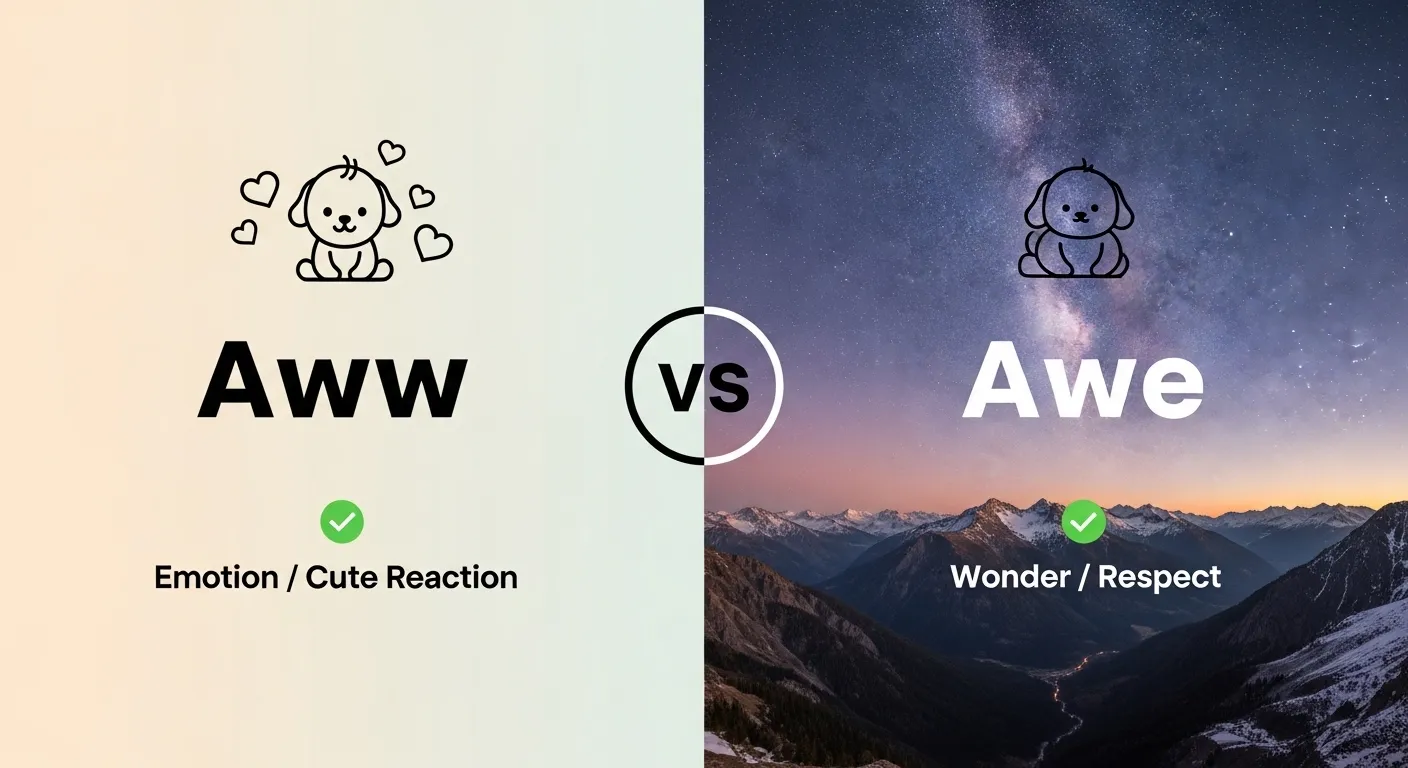
“Aww” is an emotional sound used to show love or sympathy, while “awe” is a noun that means deep respect or wonder. They sound alike but have different meanings.
Many people search for “aww or awe” because these words sound the same but are used in very different ways. This makes them easy to mix up, especially in writing.
You may see “aww” in text messages or social media when someone reacts to something cute or sad. On the other hand, “awe” is used in more formal situations to describe a strong feeling of respect or amazement.
This confusion can lead to mistakes. Using the wrong word can change the meaning of your sentence. For example, writing “I was in aww” instead of “I was in awe” is incorrect.
In this article, you will learn the meanings, origins, and correct usage of aww and awe. You will also see examples, common mistakes, and simple tips. By the end, you will know exactly when to use each word.
Aww or Awe – Quick Answer
- Aww → Expression of emotion (cute, love, sympathy)
- Awe → Feeling of wonder or deep respect
Examples:
- Aww, that baby is so cute! ✅
- I felt awe when I saw the mountains. ✅
Rule:
Use aww for reactions.
Use awe for feelings.
The Origin of Aww or Awe
The two words have different origins.
- Awe comes from Old English ege
- Meaning: fear, respect, or wonder
- Aww is a modern informal expression
- Used to show emotion in speech and writing
Over time:
- Awe became a formal word
- Aww became popular in texting and social media
They developed separately but sound the same.
British English vs American English Spelling
There is no major spelling difference between regions.
| English Type | Word | Usage Example |
| British English | Awe | She looked in awe. |
| American English | Awe | He felt awe at the view. |
| Informal (Global) | Aww | Aww, that’s adorable! |
Both regions use the same forms.
Which Spelling Should You Use?
Choose based on context, not region.
Use aww when:
- Showing emotion
- Reacting to something cute or sad
- Writing informally
Use awe when:
- Writing formally
- Describing strong feelings of respect or wonder
Audience-based advice:
- US audience → Same usage
- UK/Commonwealth → Same usage
- Global audience → Focus on meaning
Tip: Context matters more than location.
Common Mistakes with Aww or Awe
Here are common errors:
| Mistake | Correction |
| I am in aww | I am in awe |
| Awe, that’s cute | Aww, that’s cute |
| Mixing emotional and formal use | Use correct context |
| Using awe in casual reaction | Use aww |
Incorrect:
- Awe, that puppy is adorable! ❌
Correct:
- Aww, that puppy is adorable! ✅
Tip:
Aww = sound
Awe = meaning
Aww or Awe in Everyday Examples
Emails
- “I was in awe of your presentation.”
News
- “The crowd watched in awe.”
Social Media
- “Aww, this is so sweet!”
Formal Writing
- “The monument inspired awe.”
Chat Messages
- “Aww, thank you!”
Both words are used in different situations.
Aww or Awe – Usage Data
Why people search this keyword:
- Same pronunciation
- Writing confusion
- Grammar learning
Popular regions:
- United States
- United Kingdom
- India
- Pakistan
Usage contexts:
- Social media
- Messaging apps
- Academic writing
- Blogging
“Aww” is common in informal use, while “awe” is used in formal writing.
Comparison Table (Keyword Variations)
| Word | Type | Meaning | Usage |
| Aww | Expression | Emotion (cute/sympathy) | Informal |
| Awe | Noun | Wonder/respect | Formal |
| Awed | Verb form | Filled with awe | Formal |
| Awe-inspiring | Adjective | Causing wonder | Formal |
FAQs
1. What is the difference between aww and awe?
Aww shows emotion, while awe describes a feeling of wonder or respect.
2. Is “aww” a real word?
Yes, but it is informal and used in casual writing.
3. Is “awe” formal?
Yes, it is commonly used in formal and academic writing.
4. Can I use “aww” in essays?
No, it is better to avoid informal expressions in formal writing.
5. Why do people confuse these words?
Because they sound exactly the same.
6. Is there a spelling difference in US and UK?
No, both use the same spelling.
7. How can I remember the difference?
Aww = emotion, Awe = respect or wonder.
Conclusion
The difference between “aww” and “awe” is simple but important. Even though they sound the same, they have very different meanings and uses.
“Aww” is an emotional expression. It is used in casual conversations, especially online. “Awe” is a formal word that describes a deep feeling of respect or wonder.
Understanding this difference helps you avoid common mistakes. It also improves your writing by making it clearer and more accurate.
There is no difference between British and American English spelling, which makes learning easier. The key is to focus on context.
A simple way to remember is: aww = reaction, awe = feeling.
Using the correct word shows attention to detail and helps your message stay clear.
Final tip: Always think about your sentence meaning before choosing between aww and awe.
Learn more related post:
Comprable or Comparable :Which Spelling Is Correct?

I am Robert Tressell, the pen name of Robert Noonan, a British–Irish novelist and political writer. I am best known for my novel The Ragged-Trousered Philanthropists, which presents a strong depiction of working-class life and social inequality. My work remains influential in English literature and social thought.