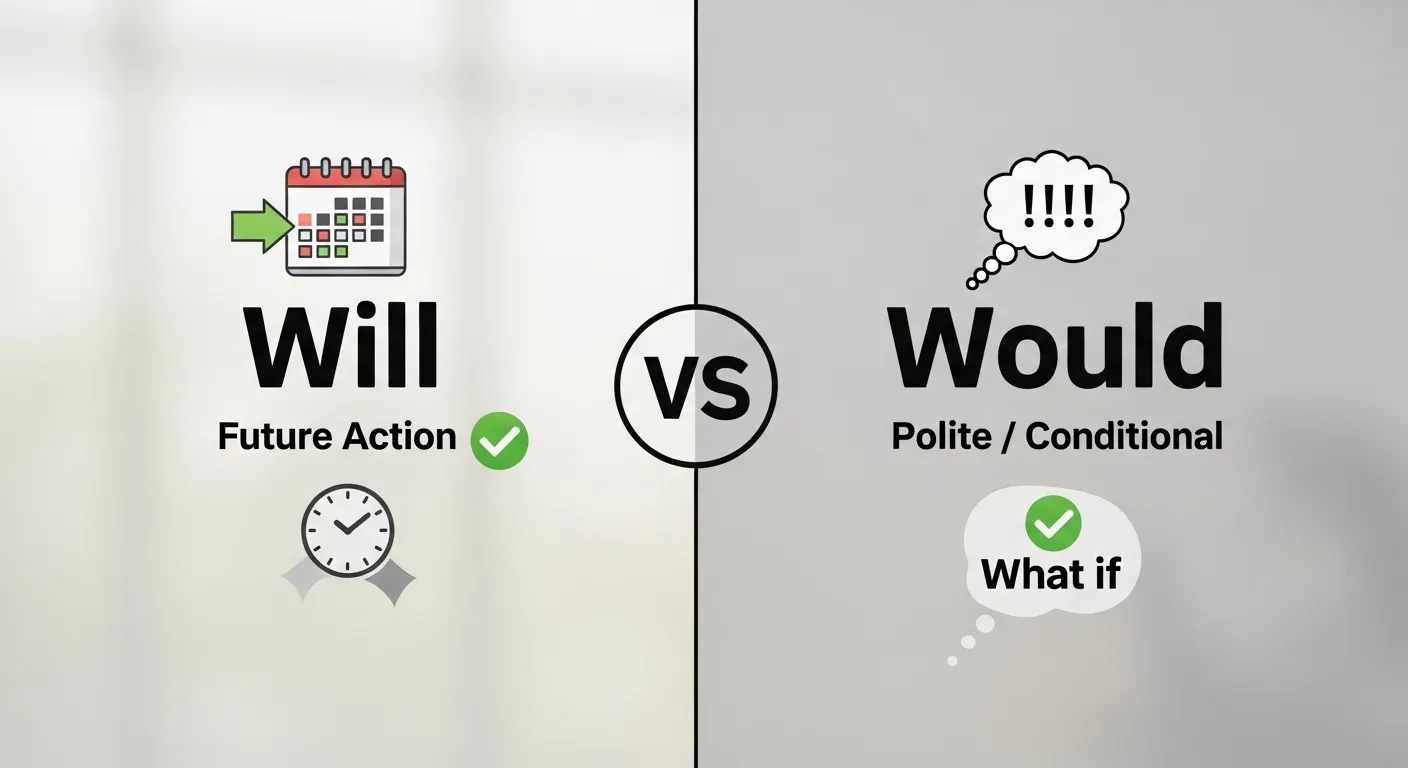
“Will” is used for future actions and decisions. “Would” is used for polite requests, imagined situations, or past forms of “will.”
Many English learners and writers feel confused about “would or will.” Both words are very common, and both talk about actions. But they are not the same. Using the wrong one can change the meaning of your sentence
This confusion happens because both words are modal verbs. They often appear in similar sentences, especially in conversation. Also, “would” is the past form of “will,” which adds more complexity.
Understanding the difference helps you speak clearly and write correctly. It also improves your tone. For example, “would” sounds more polite than “will” in many cases.
In this article, you will learn the meaning, origin, and correct use of would and will. You will also see simple examples, common mistakes, and easy rules. By the end, you will know exactly when to use each word.
Would or Will – Quick Answer
- Will → Future actions and decisions
- Would → Polite requests, imagined situations, or past form
Examples:
- I will call you tomorrow.
- I would call you if I had time.
More examples:
- She will help you.
- She would help you if she could.
Rule: Use will for real future. Use would for polite or unreal situations.
The Origin of Would or Will
Both words come from Old English.
- Will comes from willan, meaning “to want” or “to wish”
- Would is the past form of “will”
Over time:
- “Will” became a future marker
- “Would” developed uses for polite speech and conditions
Why confusion happens:
- Same root word
- Many different uses
- Similar sentence structure
Today, both words are essential in English grammar.
British English vs American English Usage
There is no spelling difference between British and American English.
| English Type | Will Usage Example | Would Usage Example |
|---|---|---|
| British English | I will go now. | I would go if I could. |
| American English | I will call you. | I would like some help. |
| Global Usage | Same rules apply | Same rules apply |
The usage is the same worldwide.
Which Form Should You Use?
Choose based on meaning, not region.
Use will when:
- Talking about the future
- Making decisions
- Promising something
Examples:
- I will finish this work.
- They will arrive soon.
Use would when:
- Making polite requests
- Talking about imagined situations
- Referring to past habits or future in the past
Examples:
- I would like some tea.
- If I were rich, I would travel the world.
Audience guidance:
- US audience → Same usage
- UK audience → Same usage
- Global audience → Same usage
Meaning decides the choice.
Common Mistakes with Would or Will
Here are frequent errors:
| Mistake | Correction |
|---|---|
| Using “will” in polite requests | Use “would” |
| Using “would” for real future | Use “will” |
| Confusing condition sentences | Learn if-clauses |
| Mixing both in same context | Keep meaning clear |
Incorrect:
- Would you come tomorrow.
Correct:
- Will you come tomorrow?
- Would you come if you were free?
Tip:
- Real action → will
- Polite or imagined → would
Would or Will in Everyday Examples
Emails
- “I will send the report soon.”
- “I would like to request information.”
News
- “The government will announce changes.”
- “Experts said the plan would help people.”
Social Media
- “I will try this today!”
- “I would love to visit this place.”
Formal Writing
- “The study will examine results.”
- “The method would improve accuracy.”
Conversations
- “I will call you later.”
- “I would help if I could.”
These words appear in all types of communication.
Would or Will – Usage Data
Why people search this keyword:
- Grammar confusion
- Similar usage
- Writing improvement
Popular regions:
- United States
- United Kingdom
- India
- Pakistan
Usage contexts:
- Daily conversation
- Academic writing
- Business communication
Both words are very common and important in English.
Comparison Table (Keyword Variations)
| Word | Function | Meaning Type | Example |
|---|---|---|---|
| Will | Modal verb | Future action | I will go tomorrow. |
| Would | Modal verb | Polite/conditional | I would go if I could. |
| Will | Decision | Real intention | I will help you. |
| Would | Request | Polite tone | Would you help me? |
FAQs
1. What is the main difference between “will” and “would”?
“Will” shows future action. “Would” shows polite or imagined situations.
2. Is “would” the past of “will”?
Yes, “would” is the past form of “will.”
3. Which is more polite?
“Would” is more polite than “will.”
4. Can I use “would” for the future?
Yes, but only in conditional or indirect speech.
5. Is there any regional difference?
No, usage is the same worldwide.
6. When should I use “will”?
Use it for real future actions and promises.
7. When should I use “would”?
Use it for polite requests and imagined situations.
Conclusion
The difference between “would” and “will” is simple when you understand their roles. “Will” is used for real future actions, decisions, and promises. It shows something that is expected to happen.
On the other hand, “would” is used for polite requests, imagined situations, and as the past form of “will.” It often adds a softer and more respectful tone to your sentences.
There is no difference between British and American English, so you only need to focus on meaning. This makes learning easier.
Using these words correctly can improve your communication. It helps you sound clear, polite, and professional. Small grammar choices like this can make a big difference.
A simple tip is to ask yourself: Is this real or imagined? If it is real, use will. If it is polite or possible, use would.
With practice, you will use both words naturally and correctly in any situation.
Learn more related article:
Ate or Eaten: Which Word Should You Use?(guide 2026)

I am Samuel Reedman, a digital English content creator who writes educational comparison posts for learners worldwide. My work emphasizes correct word usage, pronunciation differences, and practical examples for daily communication.