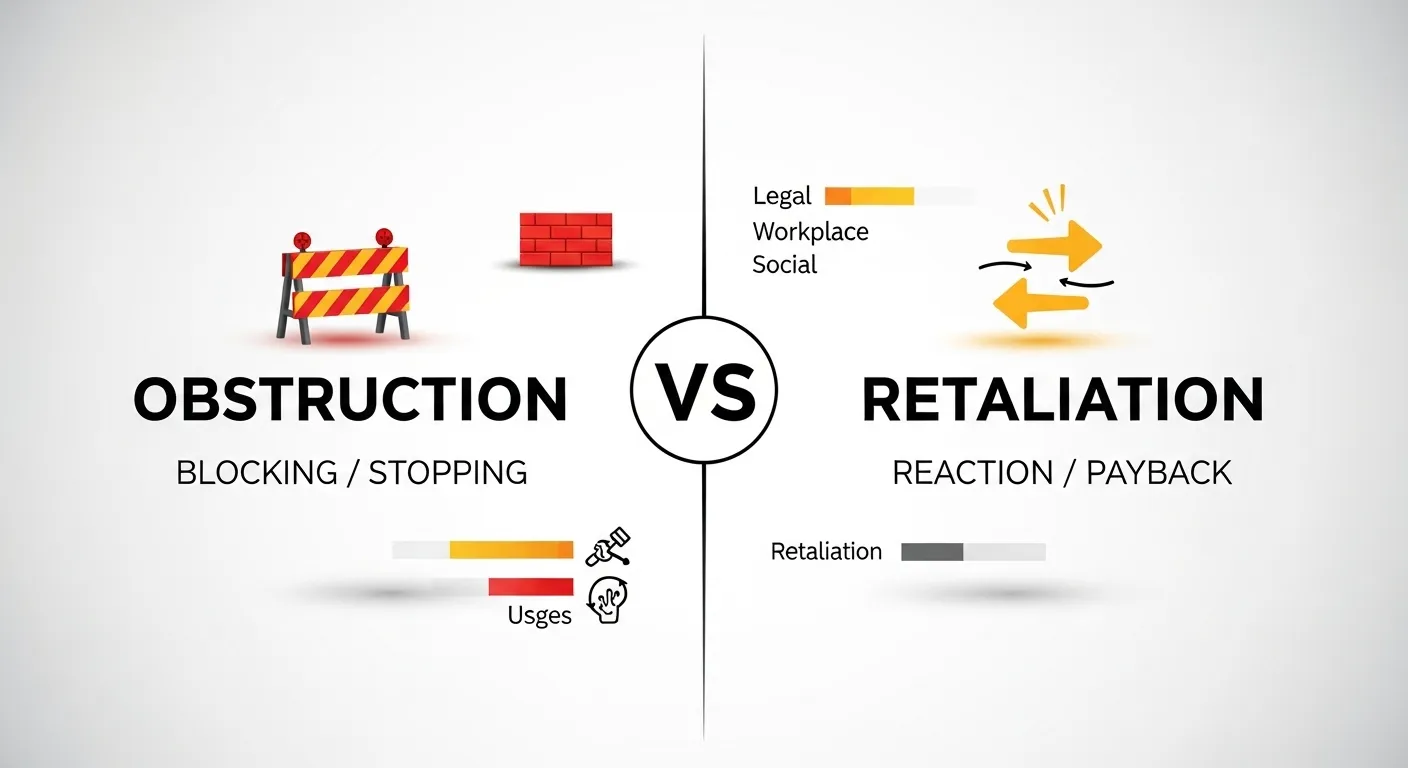
“Obstruction” means blocking or preventing something, while “retaliation” means taking revenge or responding with harm after being wronged. Both words are correct but used in different contexts.
Many people search for “obstruction or retaliation” because they are unsure about the difference between these two words.
Both are often used in legal, workplace, and everyday situations, which can make them confusing. While they may seem related, their meanings are quite different.
This confusion is common in writing, especially in reports, news, or professional communication.
Using the wrong word can change the meaning of a sentence. For example, blocking a process is not the same as taking revenge.
In this article, you will learn the clear difference between obstruction and retaliation, their origins, correct usage, and real-life examples. You will also see common mistakes and tips to avoid them. By the end, you will know exactly when to use each word with confidence.
Obstruction or Retaliation – Quick Answer
- Obstruction → Blocking or stopping something
- Retaliation → Taking revenge or responding with harm
Examples:
- The road was closed due to an obstruction. ✅
- He was fired in retaliation for complaining. ✅
Rule:
Use obstruction for blocking.
Use retaliation for reacting or taking revenge.
The Origin of Obstruction or Retaliation
Both words come from Latin roots.
- Obstruction comes from obstruere
- Meaning: “to block” or “to shut up”
- Retaliation comes from retaliare
- Meaning: “to repay” or “to pay back”
Over time:
- Obstruction became common in legal and physical contexts
- Retaliation became common in emotional, legal, and social contexts
There is no spelling confusion here. The difference is in meaning and usage.
British English vs American English Spelling
There is no difference in spelling between British and American English.
| English Type | Word | Example Sentence |
| British English | Obstruction | The obstruction caused delays. |
| British English | Retaliation | The act was seen as retaliation. |
| American English | Obstruction | Traffic stopped due to obstruction. |
| American English | Retaliation | He faced retaliation at work. |
Both words are spelled the same worldwide.
Which Spelling Should You Use?
Both words are correct, but they are used in different situations.
Use obstruction when:
- Something blocks or stops progress
- Talking about physical or legal barriers
Use retaliation when:
- Someone reacts negatively
- Talking about revenge or response
Audience-based advice:
- US audience → Use based on meaning
- UK/Commonwealth → Same usage
- Global audience → Focus on context
Choose the word based on what you want to say, not location.
Common Mistakes with Obstruction or Retaliation
Here are common errors:
| Mistake | Correction |
| Using obstruction for revenge | Use retaliation |
| Using retaliation for blocking | Use obstruction |
| Mixing legal meanings | Understand context |
| Using words interchangeably | Learn clear difference |
Incorrect:
- He blocked the road as retaliation. ❌ (better: obstruction)
Correct:
- He blocked the road, causing an obstruction. ✅
Tip: Think block vs react.
Obstruction or Retaliation in Everyday Examples
Emails
- “There is an obstruction in the process.”
- “This action may be seen as retaliation.”
News
- “The protest caused major obstruction.”
- “The decision led to claims of retaliation.”
Social Media
- “Traffic jam due to obstruction!”
- “That felt like retaliation.”
Academic Writing
- “Legal obstruction can delay justice.”
- “Retaliation affects workplace morale.”
Business Writing
- “Remove any obstruction in workflow.”
- “Avoid retaliation against employees.”
Both words are common in formal and informal contexts.
Obstruction or Retaliation – Google Trends & Usage Data
Why people search this keyword:
- Confusion between legal terms
- Writing clarity
- Professional communication needs
Popular regions:
- United States
- United Kingdom
- India
- Pakistan
Usage contexts:
- Legal writing
- Workplace policies
- News and media
- Academic content
Both words are widely used but in different contexts.
Comparison Table (Keyword Variations)
| Word | Meaning | Usage Context | Example |
| Obstruction | Blocking or stopping | Physical/Legal | Road obstruction |
| Retaliation | Revenge or response | Emotional/Legal | Workplace retaliation |
| Obstruct | Verb (to block) | Action | They obstructed the path |
| Retaliate | Verb (to respond) | Action | He retaliated quickly |
FAQs
1. What is the main difference between obstruction and retaliation?
Obstruction blocks something, while retaliation is a response or revenge.
2. Can these words be used interchangeably?
No, they have different meanings.
3. Is obstruction always physical?
No, it can also be legal or procedural.
4. Is retaliation always negative?
Usually yes, as it involves revenge or harm.
5. Are these words used in legal writing?
Yes, both are common in legal contexts.
6. Do UK and US English differ in spelling?
No, both use the same spelling.
7. How can I remember the difference?
Think: obstruction = block, retaliation = react.
Conclusion
The difference between “obstruction” and “retaliation” is clear once you understand their meanings. Obstruction refers to blocking or preventing something, while retaliation refers to reacting, often with revenge or negative intent. These words are not interchangeable and should be used carefully.
Both words come from Latin roots and are widely used in modern English. There is no difference between British and American spelling, which makes learning easier. The key is to focus on context.
In everyday writing—emails, reports, or social media—using the correct word improves clarity. In professional or legal writing, the difference becomes even more important. A small mistake can change the meaning of your message.
To avoid confusion, remember a simple rule: obstruction blocks, retaliation reacts. This will help you choose the right word every time.
Final tip: Always think about the situation before choosing the word.
Learn more article:
Recur or Reoccur: What’s the Difference ? (guide 2026)

I am Robert Tressell, the pen name of Robert Noonan, a British–Irish novelist and political writer. I am best known for my novel The Ragged-Trousered Philanthropists, which presents a strong depiction of working-class life and social inequality. My work remains influential in English literature and social thought.