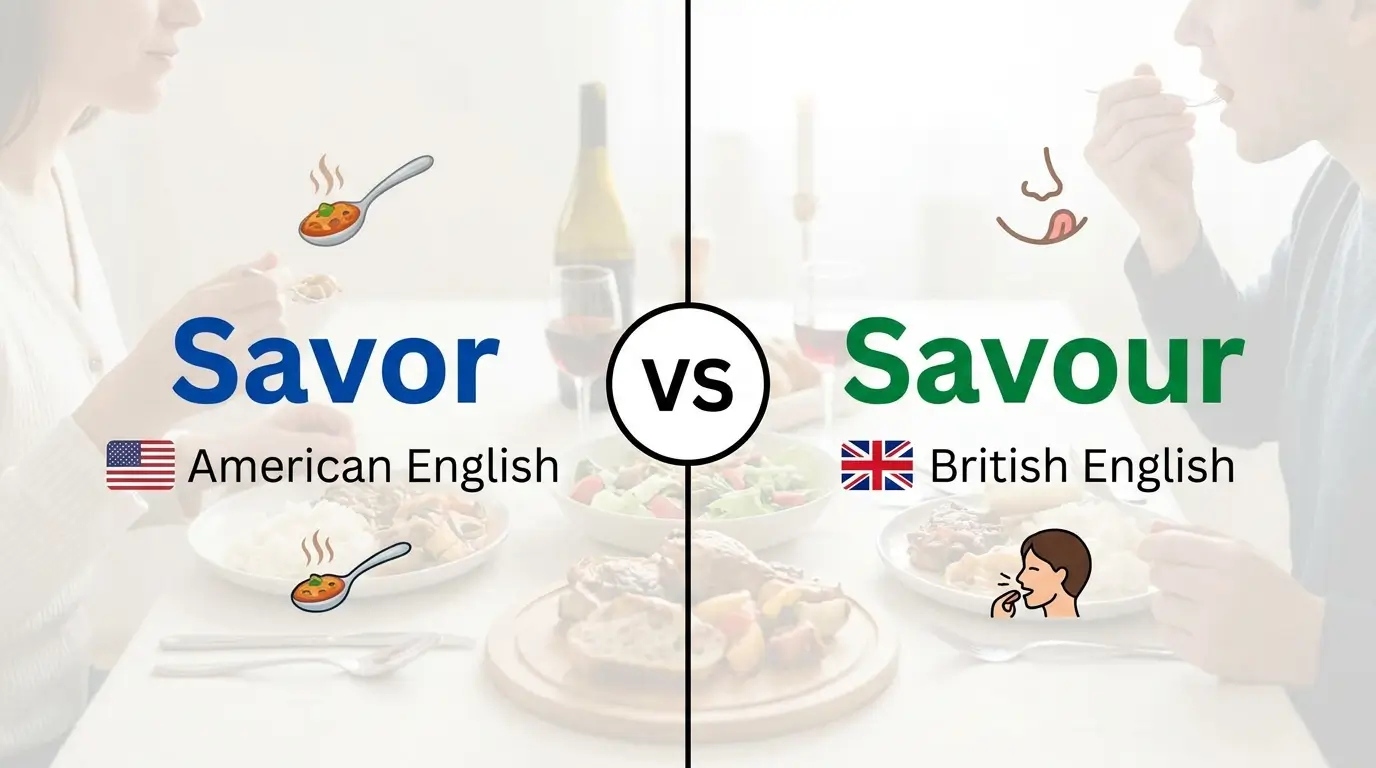
Both “savor” and “savour” are correct. “Savor” is used in American English, while “savour” is used in British English and Commonwealth countries.
Many writers get confused about “savor or savour.” Both words look correct, and both appear in books, recipes, and online content. This makes it hard to choose the right spelling.
This confusion happens because English spelling changes by region. In the United States, many words drop the letter “u.” In the United Kingdom and other countries, the “u” stays. This pattern appears in many words like “color/colour” and “flavor/flavour.”
Knowing the difference helps you write clearly and match your audience. It also makes your writing look more professional and consistent.
In this article, you will learn the meaning, origin, and correct use of savor and savour. You will also see examples, common mistakes, and simple tips. By the end, you will know which spelling to use with confidence.
Savor or Savour – Quick Answer
- Savor → American English
- Savour → British English
Meaning:
The word means to enjoy taste or experience fully.
Examples:
- Take time to savor the moment.
- She likes to savour every bite.
Rule: Choose based on region.
The Origin of Savor or Savour
The word comes from Old French saveur, meaning “taste” or “flavor.”
Over time:
- British English kept the spelling savour
- American English simplified it to savor
Why different spellings exist:
- American English removed silent letters
- British English kept traditional forms
- Language changed differently in each region
Both forms are correct today.
British English vs American English Spelling
There is a clear spelling difference.
| English Type | Preferred Form | Example Sentence |
| British English | Savour | She savoured the meal slowly. |
| American English | Savor | He savored the moment. |
| Global Usage | Both | Depends on audience |
This pattern is similar to “honor/honour.”
Which Spelling Should You Use?
Your choice depends on your audience.
Use savor when:
- Writing for US readers
- Following American style
- Creating business or online content
Use savour when:
- Writing for UK or Commonwealth readers
- Following British spelling
- Writing academic or formal UK content
Audience guidance:
- US audience → Savor
- UK/Commonwealth → Savour
- Global audience → Choose one and stay consistent
Consistency is key.
Common Mistakes with Savor or Savour
Here are common errors:
| Mistake | Correction |
| Mixing both spellings | Choose one style |
| Thinking one is wrong | Both are correct |
| Using wrong form for audience | Match region |
| Inconsistent spelling | Keep same form throughout |
Incorrect:
- She likes to savor and savour food (mixed usage).
Correct:
- She likes to savor food.
- She likes to savour food.
Use one form in a single text.
Savor or Savour in Everyday Examples
Emails
- “Take time to savor this success.”
News
- “Fans savoured the victory.”
Social Media
- “Savor every moment of life!”
Formal Writing
- “The author encourages readers to savour experience.”
Food Blogs
- “Savor the rich flavor of this dish.”
Both forms are common in daily use.
Savor or Savour – Usage Data
Why people search this keyword:
- Spelling confusion
- Regional differences
- Writing improvement
Popular regions:
- United States → Savor
- United Kingdom → Savour
- India and Pakistan → Mixed usage
Usage contexts:
- Food writing
- Lifestyle content
- Academic and business writing
Both spellings are widely used worldwide.
Comparison Table (Keyword Variations)
| Word | Status | Region | Usage |
| Savor | Correct | US | Common in general writing |
| Savour | Correct | UK | Common in formal writing |
| Savored | Correct | US | Past tense |
| Savoured | Correct | UK | Past tense |
FAQs
1. Is “savor” correct?
Yes, it is correct in American English.
2. Is “savour” correct?
Yes, it is correct in British English.
3. Do both words mean the same?
Yes, both mean to enjoy fully.
4. Which spelling is more common?
“Savor” is more common globally.
5. Can I use both in one article?
No, it is better to stay consistent.
6. Is there a meaning difference?
No, only the spelling differs.
7. Which should I use for global readers?
“Savor” is often a safe choice.
Conclusion
The difference between “savor” and “savour” is simple and easy to understand. Both words are correct and have the same meaning, but they follow different regional spelling rules.
“Savor” is used in American English and is common in online content, business writing, and everyday communication. “Savour” is used in British English and appears more in formal or academic writing.
There is no difference in meaning, so your choice depends on your audience. Once you know who you are writing for, the decision becomes clear.
Using the correct spelling helps your writing look clean, clear, and professional. It also shows that you understand language differences and care about detail.
A simple rule is to use “savor” for US readers and “savour” for UK readers. If your audience is global, pick one style and stay consistent.
Clear and correct spelling makes your message stronger and easier to understand.
Learn more article:
Would or Will: What’s the Difference ?(guide 2026)

I am Robert Tressell, the pen name of Robert Noonan, a British–Irish novelist and political writer. I am best known for my novel The Ragged-Trousered Philanthropists, which presents a strong depiction of working-class life and social inequality. My work remains influential in English literature and social thought.